


Look at the numbers. They are stark.
A new study by AWS and Strand Partners, titled “Engines of Growth,” drops a heavy truth on the table. Saudi AI-native startups are nearly five times more likely to hit $1 million in annual revenue compared to their traditional counterparts.
Five times. Not five percent.
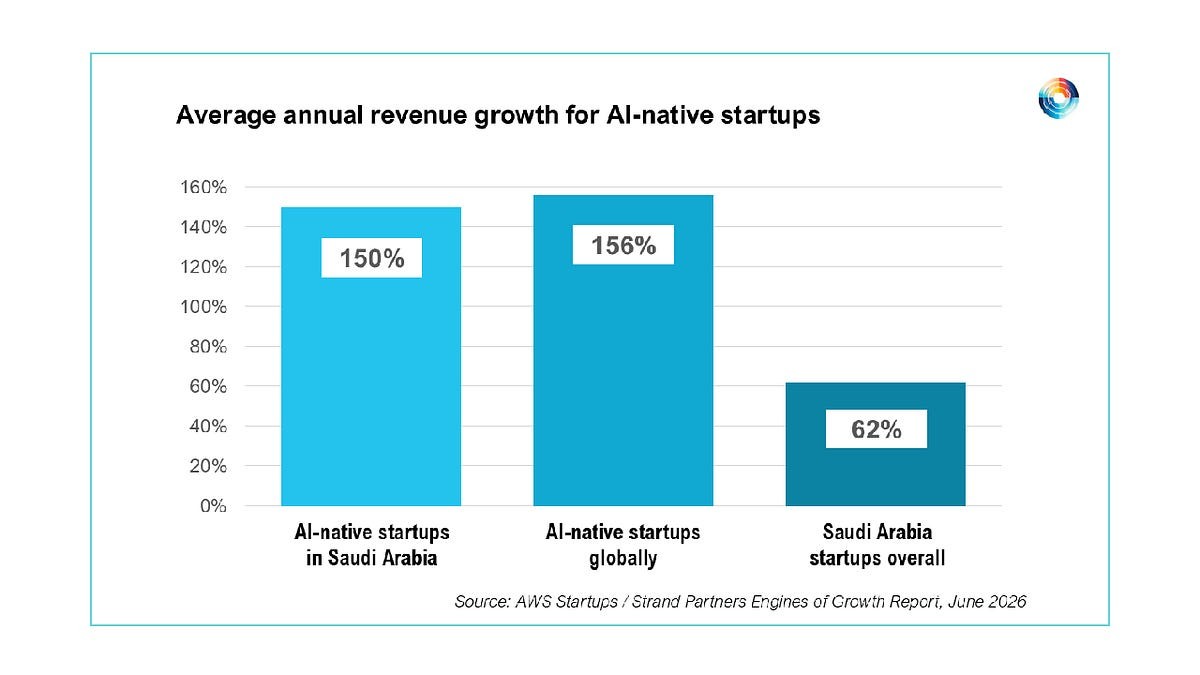
The report surveyed 3,413 founders across 20 countries. The data doesn’t lie. Saudi AI-native firms posted 150% average annual revenue growth. That sits right next to the global AI-native average of 156%. Meanwhile, the rest of Saudi Arabia’s startup ecosystem crawled along at 62% growth.
It is a wide gap.
How much do Saudi AI startups actually earn?
You want to know the money breakdown. Here it is.
48% of Saudi AI-native startups generate over $400,000 in revenue per employee. Traditional Saudi startups? Only 28%.
Efficiency matters. These companies aren’t just burning cash. They are building machines that print value.
But there is a catch. A small one.
Only 15% of Saudi startups qualify as AI-native. Compare that to the US at 30% or Singapore at 27%. The Kingdom has a tiny slice of the pie. The big question isn’t whether AI startups can win. It’s whether Saudi Arabia can build enough of them.
If they don’t, foreign firms will just sell software into the market instead. The Kingdom’s tech sector benefits less.
Why do AI-native companies grow faster?
It comes down to strategy. And proprietary tech.
Most AI-native startups in Saudi Arabia have done their homework.
- 72% have a formal, comprehensive AI strategy. (The global average is 68%. General Saudi startups are at 56%.)
- 63% have built proprietary AI capabilities like custom models. (Only 35% of traditional startups do.)
- 98% use cloud services. (Standard startups lag at 75%.)
They are not just plugging in an API and calling it a day. They are engineering specific solutions.
Productivity jumps follow. 89% of these AI-native firms report gains from AI adoption. That beats the 64% reported by the wider pool.
What about R&D? 45% use AI for research and development. 27% use it for simulations or digital twins. Both figures lead the local average.
Which sectors are leading the charge?
It is not just tech for tech’s sake.
Globally, AI-native startups are hitting billion-dollar valuations in about 3.5 years. That is half the time it took before late 2022 when generative AI took off.
But where are they?
They cluster in financial services, healthcare, life sciences, and energy. They are applying AI to transform old, established industries. Not reinventing the wheel. Making the wheel spin faster.
Capital is still the choke point. 75% of AI-native founders say money is their biggest constraint. Talent shortages come next at 56%. Regulatory complexity hits 49%.
In Saudi Arabia specifically, only 51% raised their AI spend last year. That is higher than the 29% general startup rate but lower than the 46% global AI-native average.
Investors are hesitant. Or maybe just cautious.
The path is clear. Build custom models. Have a real strategy. Hire the talent. The revenue follows. But the pool is small. Only 15%.
Will it grow to match the US or Singapore? Or will the gap stay wide?
The data gives no answer there. Just the lead. And the gap.