


The FBI’s Carnivore program sent shivers down the spine of privacy advocates when it broke the news cycle. It sounded like something out of a dystopian novel, specifically George Orwell’s 1984. The agency claimed it was a necessary tool to track suspected criminals in the digital age. Critics disagreed, seeing it as a massive overreach into private communications.
The government eventually pulled the plug on Carnivore in January 2005. They switched to off-the-shelf commercial surveillance tools. But the technical architecture of that abandoned system still offers a fascinating look at how digital monitoring evolved.
From Omnivore to DragonWare
Carnivore wasn’t the FBI’s first attempt at digital wiretapping. It was the third generation of their online detection software. The first version remains a mystery. Some experts suspect it was just Etherpeek, a standard commercial network analysis tool.
In 1997, they deployed the second generation: Omnivore.
According to FBI disclosures, Omnivore sat on an Internet service provider (ISP) network. Its job was simple. It watched email traffic. It picked out messages from a specific target source. Then it saved them to a tape drive or printed them out in real-time.
This system retired in late 1999. It was replaced by something more robust: the DragonWare Suite.
DragonWare didn’t just save emails. It reconstructed them. It could rebuild downloaded files. It could even piece together web pages. The suite had three main components, though the FBI kept the details tight.
- Carnivore : The capture engine. It ran on Windows NT or 2000.
- Packeteer : Purpose unknown officially. Likely handled reassembling fragmented data into readable messages.
- Coolminer : Also opaque. Probably analyzed the extracted data for patterns.
We know very little about Packeteer and Coolminer. But Carnivore’s role was clear. It was a packet sniffer.
The Mechanics of Packet Sniffing
This technology isn’t new. Network administrators have used packet sniffers for decades. They use them to fix broken connections or diagnose latency issues.
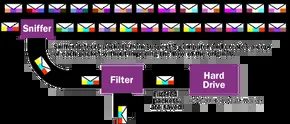
A packet sniffer is a program that sees everything on the network it touches. Normally, your computer ignores traffic not meant for it. It only reads packets addressed to its specific hardware.
A sniffer changes that rule.
When you configure a sniffer, you put the network interface into promiscuous mode. This forces the card to read every single packet passing by, regardless of the destination address. The amount of data you see depends on where you plug in. A workstation on a side branch sees limited traffic. A main server sees almost everything.
You can run these tools in two ways:
- Unfiltered : You grab every packet.
- Filtered : You only capture packets with specific criteria, like a target email address.
The filtered copies get stored in memory or on a hard drive. Analysts can then go through them line by line.
What the FBI Could See
When you connect to the web, you are tapping into your ISP’s network. If you place a sniffer at an ISP server, you have a broad view of user activity.
Carnivore could potentially monitor:
- Which websites you visited
- The specific pages you viewed
- Who you emailed
- The content of those emails
- Files you downloaded
- Streaming media usage
- Visitors to your own website
Is this really a new threat? Probably not. Many ISPs use sniffers for diagnostics. Many keep email backups for storage. The FBI’s move was controversial because it formalized and scaled this access for law enforcement. The technology itself was just an evolution of existing network management tools.

The mechanics of Carnivore were less about magic and more about bureaucratic procedure meeting hardware. It started with a court order. The FBI needed reasonable suspicion that a suspect was involved in criminal activity. They didn’t just ask for a peek; they requested a full content-wiretap authorization. This distinction matters. In telephone surveillance terms, a content-wiretap captures everything inside the communication packet. It’s the digital equivalent of listening to the conversation, not just who is talking.
Compare that to a trap-and-trace order. That only gets metadata—the destination. Who is the email going to? What website is being visited? Then there’s the reverse: the pen-register. That tracks where an incoming message originates. But Carnivore was built for the heavy lifting. It was designed for the content.
The Hardware Setup
The FBI didn’t just install software on their own laptops. They went to the source. They contacted the Internet Service Provider (ISP) hosting the suspect’s account and requested access to backup files. Then they brought their own rig to the ISP’s server room.
This machine wasn’t some futuristic black box. It was a Pentium III running Windows NT or 2000. It had 128 megabytes of RAM. That sounds laughable today, but it was serious business in the late 90s. The system relied on three layers of software: commercial communications tools, a custom C++ application for packet sniffing and filtering, and a physical lockout system. You needed a special passcode to touch the hardware. No unauthorized personnel. No curious technicians.
Crucially, the setup included a network isolation device. This made the Carnivore system invisible to the rest of the ISP’s network. It was a ghost. You couldn’t hack it from another computer because, to the network, it didn’t really exist. Storage was handled by a 2-gigabyte Iomega Jaz drive. These were removable cartridges, swappable like floppy disks but with significantly more capacity. The captured data lived here.
Filtering the Noise
Configuration was specific. The FBI plugged in the suspect’s IP address. Carnivore ignored everything else. It sat passively, copying packets without disrupting traffic. If the network slowed down, it wasn’t because of Carnivore. It was because the system was doing exactly what it was told: nothing but copying.
Once copied, the data hit a filter. This was the smart part. The software identified protocols. It looked for Simple Mail Transfer Protocol (SMTP) signatures. SMTP is the standard for email. By filtering for SMTP, Carnivore stripped away the noise—web browsing, FTP transfers, chat logs. It kept only the email packets. These were saved to the Jaz cartridge.
An FBI agent would visit the ISP every day or two. They’d physically swap the cartridge. The process was rigid. The cartridge went into a dated, sealed container. If that seal broke, the person handling it had to sign, date, and reseal it immediately. Otherwise, the evidence was considered compromised. Chain of custody was everything.
The surveillance had a hard limit. A month max without a court extension. When the time was up, the hardware was removed. The data on the cartridge was processed using Packeteer and Coolminer tools. If the emails provided enough evidence, they went to court. If not, they were discarded. The ISP itself didn’t keep records of the activity during this window. They were just the venue.
Why Target Specific Crimes?
Carnivore wasn’t a fishing rod. It was a spear. The FBI planned to use it for specific, high-stakes investigations. You didn’t get a court order for Carnivore to catch a local shoplifter. The targets were:
- Terrorism
- Child pornography and exploitation
- Espionage
- Information warfare
- Fraud
The criteria were strict. The suspicion had to be substantial. The court order had to be specific. This wasn’t about general surveillance. It was about targeted interception of electronic communications for serious federal crimes.
The Backlash
The technology worked, but the reaction was fierce. Privacy advocates saw a nightmare scenario. The Electronic Communications Privacy Act (ECPA) provided legal protections for electronic communication. Any surveillance required probable cause and a court order. Using Carnivore outside these bounds was illegal. It bordered on unconstitutional. The potential for abuse was the elephant in the room. Critics argued the system was too opaque.
Then there was the fear of regulation. Some believed Carnivore was the first step toward the U.S. government seizing control of the Internet. The idea was that the FBI would place these systems at every ISP—private, commercial, educational. Theoretically possible for U.S.-based providers. Impossible for those outside U.S. jurisdiction. The infrastructure required would be massive. And the opposition would be universal.
Free speech concerns were equally loud. Rumors swirled that Carnivore monitored all content, scanning for keywords like “bomb” or “assassination.” Any packet sniffer can be configured to look for patterns. But without probable cause, monitoring your general activity was a violation of the ECPA and the First Amendment. The FBI maintained they only looked at what the court order specified. They refused to disclose the source code. This secrecy only fueled paranoia.
Many confused Carnivore with Echelon. Echelon was a rumored NSA network designed to capture international packets containing specific keywords. There was little hard evidence Echelon even existed in the way people described. But the conflation damaged Carnivore’s reputation. It became a symbol of government overreach.
The implementation was an uphill battle. The FBI had to justify every move. They had to prove they were following the law. But within the constraints of the ECPA, Carnivore remained a potent tool. It showed that digital surveillance was no longer science fiction. It was operational. And it changed how we think about privacy in the digital age.
How Did Carnivore Handle Data Privacy?
The system was designed to minimize data collection. By filtering for SMTP protocols, it ignored non-email traffic. The isolation device prevented external access. The physical lockout ensured only authorized agents could touch the hardware. The sealed cartridge system maintained chain of custody. These were safeguards. But they relied on the agents following procedure. One mistake could compromise the evidence. Or the privacy of innocent parties.
Why Was Carnivore Controversial?
Secrecy was the main issue. The FBI wouldn’t release the source code. They wouldn’t explain the filtering algorithms in detail. This lack of transparency made it easy for critics to assume the worst. Was it scanning for keywords? Was it storing more data than necessary? Without verification, the public had to guess. And people guessed the worst.
What Happened After Carnivore?
The technology evolved. Newer versions faced stricter scrutiny. Legal frameworks adapted. But the core tension remained. Law enforcement needs tools to catch criminals. Citizens expect privacy. The balance is fragile. Carnivore was just one piece of that puzzle. A large, loud, and controversial piece.
Can Email Really Be Monitored This Easily?
Technically, yes. If you have physical access to the network and legal authority. The ISP’s cooperation is essential. Without it, the hardware is useless. The FBI couldn’t just tap a wire from their office. They had to be on-site. This physical requirement added a layer of friction. It made mass surveillance impractical. But targeted surveillance? Very easy.
The legacy of Carnivore isn’t just in the hardware. It’s in the debate it sparked. It forced a conversation about encryption, privacy laws, and government power. That conversation didn’t end. It just moved to the cloud. And the stakes are higher now.
The FBI’s Secret Packet Sniffer
Carnivore wasn’t some abstract concept or a piece of theoretical code. It was a real, deployed surveillance system. And it was run directly by the FBI.
For years, the agency kept its methods tightly shielded from public view. The software acted as a packet sniffer. It sat behind web servers or internet service providers. It captured data moving through the network. Email contents. Chat logs. Web browsing history. All of it.
The controversy wasn’t just about what it did. It was about how it did it. Privacy advocates saw it as a backdoor into private communications. Technical reviewers pointed out flaws in its security protocols. Was it actually secure? Or was it just another layer of vulnerability?
“It is a tool. Like any tool, its impact depends on who holds it and how they use it.”
The program eventually underwent scrutiny. Internal reviews. Public outcry. The FBI itself acknowledged the need for change. By 2005, the name Carnivore was retired. Replaced by something less provocative. But the underlying capability remained.
How It Actually Worked
Carnivore was designed to be unobtrusive. It was installed on a server. Not on the FBI’s own machines. On the provider’s infrastructure. This made detection difficult.
It filtered data based on keywords or IP addresses. If a match was found, that packet was copied. The rest of the traffic? It flowed past unnoticed. To the user. To the ISP. To anyone watching the surface-level activity.
The technical architecture was simple. But the implications were massive. It bypassed traditional wiretap laws. Which were built for phone lines. Not for digital streams.
Why It Matters Today
The technology has evolved. The name has changed. But the core function persists. Government agencies still need access to digital communications. The methods are more sophisticated now. More distributed. Less centralized.
But the fundamental question remains the same. Who watches the watchers? And what happens when the tools of surveillance outpace the laws designed to control them?
The answer isn’t in the code. It’s in the policy. And policy moves slower than software.


