




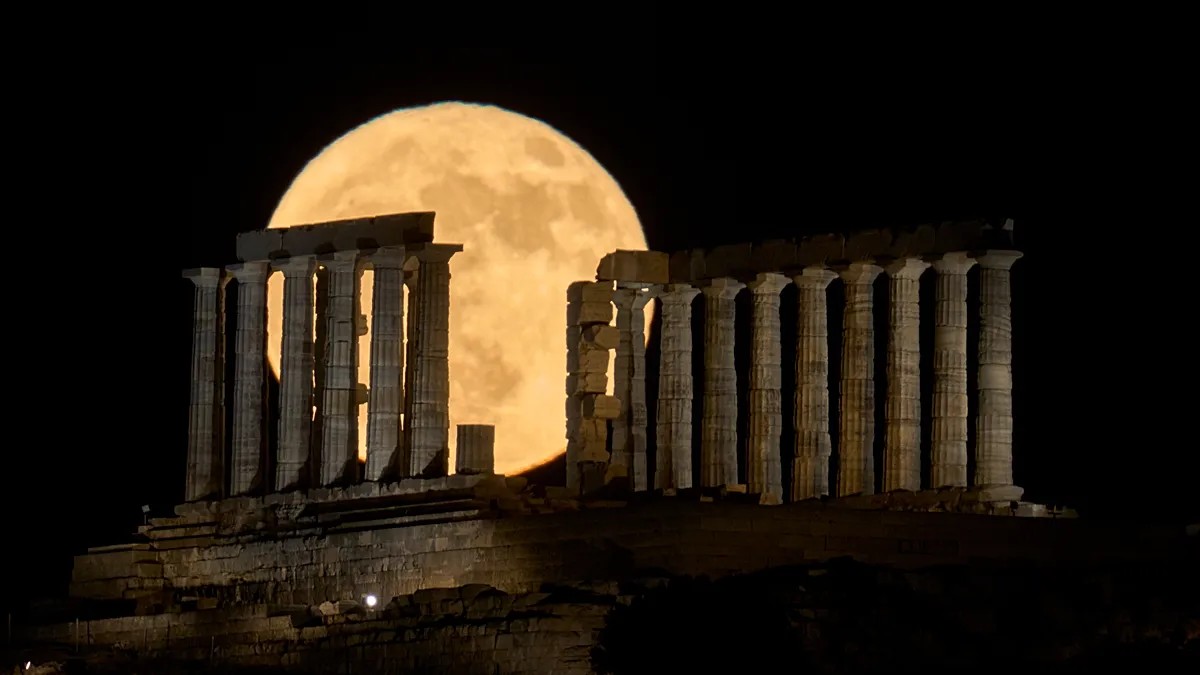
Tonight, look up. It’s called the Strawberry Moon. It has no business being red. In fact, in most of Europe, strawberry season is over anyway.
The name comes from the first full moon of summer. It rises opposite the Sun, right after the solstice. Long light, long evenings, short shadows. This year it peaks Tuesday morning at 01:57 CEST, but you won’t need an alarm. You’ll see it tonight.
- London: ~9:41 pm
- Paris: 22:13
- Berlin and Madrid: 21:55
The title belongs to the Algonquian people. They used the moon as a calendar. A signal to gather wild strawberries. The Old Farmer’s Almanac caught on, the rest is history. But others had ideas too.
- Cherokee: Green Corn Moon
- Cree: Moon When Leaves Come Out
- Tlingit: Birth Moon
- China: Lotus Moon
The Europeans? They liked honey. Or at least the Anglo-Saxons did, harvesting hives while mowing meadows. Have no confusion here: this is not about flying to Bali for your honeymoon.
If Euronews Next named it, we’d call it the Heatwave Moon. It is burning.
What You’ll Actually See
Forget red. Forget strawberries. Expect gold.
The moon hugs the southern horizon. Its light fights through a thick, slanted wedge of atmosphere before hitting your eyes. It’s the same physics as sunset. Dust, gas, scattering light. The result? A warm glow.
But here’s the kicker. It’s small.
This is a micromoon.
It sits roughly 406,290 kilometers away. That’s about 21,004 km farther than average.
That makes it 7 percent smaller and 10 percent dimmer. Boring, really. A supermoon would be 14 percent wider, 30 percent brighter. You could feel it, almost. This one whispers. It’s the second smallest full moon of 2026. Last month’s Blue Moon was 102 kilometers closer. Not a lot.
It traces a low path across the Northern Hemisphere sky. Decades-low, practically. Because it rose just eight days after the solstice. When the sun climbs high, the moon sinks. Geometry.
In the Southern Hemisphere? The script flips. The moon shoots high. It is the highest full moon of the year. Australia, finally, gets a win.
One interesting detail.
Look at the moon and you’re staring toward the Milky Way’s core. The Strawberry Moon hangs in front of Sagittarius, specifically the Teapot asterism. It points right at the galactic center. Coincidence? No. But it’s nice.
Watch it right after sunset. Wait until it clears the southeastern horizon. The atmosphere will do its thing, turning that gold deeper. It’ll be nearly full. Stay full until tomorrow.
As for the strawberries, they are likely gone.