



The internet didn’t appear out of thin air. It has a direct lineage to a specific project funded by the US Defense Department in the late 1960s. That project was ARPANET.
Advanced Research Projects Agency Network was an experimental computer network. It served as the forerunner to everything we call the internet today. The Advanced Research Projects Agency (ARPA) bankrolled the initiative. The goal was simple on paper. Link computers at Pentagon-funded research institutions. They did this over existing telephone lines.
“ARPANET’s purpose was always more academic than military”
Cold War paranoia shaped the architecture. Military commanders needed a communications system without a central core. They feared a single point of failure. If an enemy attacked the headquarters or base of operations, the entire network could go dark instantly. One strike could black out all data.
The solution was a decentralized design. There was no main hub. No central brain to destroy. This led to the tentacle-like structure we see today. Academic facilities joined the network. They expanded its reach beyond military labs. The internet essentially retains that form. Just on a much larger scale.
We still use this logic every day. When you load a webpage, you aren’t connecting to one server. You are navigating a web of connections. It’s a design born from fear. And it works because of it.
The Human Side of ARPANET
Cold War paranoia birthed the internet. That’s the blunt truth. In the 1960s, military leaders feared Soviet jet bombers launching surprise nuclear strikes. They needed a command structure that wouldn’t crumble under pressure. So they built SAGE (Semi-Automatic Ground Environment). It was a massive undertaking costing $61 billion and taking six years to deploy.
SAGE used 23 direction centers. Each housed a mainframe computer capable of tracking 400 aircraft simultaneously. It could tell a friendly Cessna from a hostile bomber. But the name said it all. It was only semi -automatic. Humans had to make the final calls.
This limitation became the seed for something far bigger.
Joseph Carl Robnett Licklider saw the potential in that human interaction. He called it man-computer symbiosis in a 1960 essay. His idea was radical: pair the human mind with computer speed and logic. Better decisions would follow.
In 1962, Licklider joined ARPA. He ran the Information Processing Techniques Office (IPTO) for just two years. That short stint changed everything. He renamed his office from Command and Control Research to IPTO. He pushed for interactive computing. He believed humans and machines working together could create a better world.
Funding followed his vision. During his time at IPTO, ARPA funded roughly 70 percent of all U.S. computer-science research. It wasn’t a stifling military bunker. It was a playground for radical ideas. ARPANET wasn’t just about defense. It was about graphics. Parallel processing. Flight simulation. And networking.
Why Taylor Switched On the Network
Ivan Sutherland took over IPTO in 1964. Robert Taylor followed in 1966. Taylor noticed something strange in his Pentagon office.
He had three teletype terminals. Each one connected to a different remote, time-sharing mainframe.
1. Systems Development Corp in Santa Monica.
2. UC Berkeley’s Genie Project.
3. MIT’s Compatible Time-Sharing System (Multics).
Taylor watched the screens. The computers lit up. Local users connected. They exchanged messages. They shared files. Interactive communities formed around the hardware.
Taylor realized the inefficiency. Why need three separate machines to talk to three incompatible systems? It made no sense. He wanted one protocol. One language. One way for any terminal to talk to any computer.
That observation led directly to the proposal for ARPANET development. He secured the funding. The vision was clear: link researchers and computers regardless of location.
The Birth of a Public Plan
The blueprint hit the public eye in October 1967. An ACM symposium in Gatlinburg, Tennessee, announced the plan. The goal? Link 16 ARPA-sponsored universities and research centers across the U.S.
It was a risky bet. Charles M. Herzfeld, former ARPA director, noted that the military role was secondary. The real goal was connecting people. No one knew if it would work. The initial $1 million came from diverted ballistic-missile defense funds.
In summer 1968, the Defense Department asked for bids. Bolt, Beranek, and Newman (BBN) of Cambridge, Massachusetts, won the $1 million contract in January 1969.
Taylor became the evangelist for this new world. He teamed up with Licklider again. In 1968, they published “The Computer as a Communication Device” in Science and Technology.
The opening line was a shock.
“In a few years, men will be able to communicate more effectively through a machine than face to face.”
They predicted global online communities. Mood-sensing interfaces. The first public glimpse of networked digital computing’s potential. It drew researchers in. It set the stage for the rest of the story.
ARPANET wasn’t built for convenience. It was built to survive. The goal was simple: share data across huge distances without relying on fragile, dedicated phone lines. If a line went down, the connection died. That was unacceptable for a network intended to withstand catastrophe. The solution? Packet switching.
Paul Baran at the RAND Corporation had already figured this out. He was tasked with designing a communication grid that could survive a nuclear strike. His answer was “hot-potato routing.” The military ignored him. His 1964 paper was classified, shelved, and forgotten.
Fortunately, it ended up in the hands of ARPA researchers. They dug it up. They realized it was the missing link. Baran’s concept became the backbone of ARPANET and, by extension, the modern internet. Without packet switching, the web as we know it wouldn’t exist.
What actually is a data packet?
Think of a large file like an email or a video. Packet switching breaks it into tiny, manageable chunks. These chunks don’t all travel the same way. They don’t even need to arrive in order.
Each packet carries a header. It’s a label that says: “I am part of message #402. I am fragment B. Reassemble me after A and before C.”
There’s also math involved. Checksums verify the data wasn’t corrupted in transit. If a packet is lost, the system requests a resend. The network uses computerized switches to route these packets along paths of least resistance. This prevents the kind of logjams that happen on dedicated lines. It’s efficient. It’s resilient. And it works around existing telephone infrastructure.
The crash that started it all
Late in 1969, UCLA graduate students under Leonard Kleinrock prepared to send the first message. The target was the Stanford Research Institute. Charley Kline was the person typing.
He logged in. He typed “L-O-G”. The system crashed.
The letter “G” was never typed. The first transmission over the ARPANET failed immediately.
It wasn’t a grand launch. It was a glitch. But the bugs were fixed quickly. Connections became flawless. The limitations were obvious at first. You could log into remote machines, print to remote printers, or transfer files. That was it. Three functions. Nothing flashy.
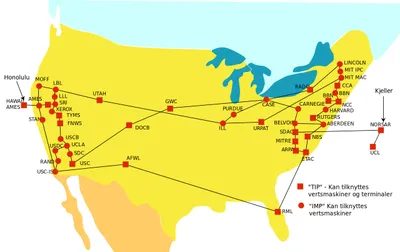
Yet the interest was intense. Academic institutions scrambled to get on board. By the end of 1969, UC Santa Barbara and the University of Utah were connected.
Exponential growth
The network grew fast. Too fast for some early expectations.
- April 1971 : 15 nodes. 23 host terminals.
- Key additions : BBN (the contractor), MIT, RAND, NASA.
- January 1973 : 35 nodes.
- 1976 : 63 connected hosts.
It was a testbed. Every day brought new experiments. Protocols evolved. Telnet emerged for remote login. File Transfer Protocol (FTP) standardized moving data. Network Control Protocol (NCP) kept the connections stable.
But the killer feature arrived quietly. In 1971, Ray Tomlinson at BBN wrote the first email program. He didn’t invent the concept of messaging, but he made it workable on ARPANET.
The community adopted it instantly. Then came mailing lists. Virtual discussion groups formed overnight. SF-LOVERS became one of the first lists, dedicated to science fiction fans. It was informal. It was human. It was nothing like the rigid, military-grade data transfer the network was designed for.
The infrastructure for survival had birthed a culture of connection. The packets were still moving. The routes were still shifting. But the purpose had changed. It wasn’t just about keeping data alive anymore. It was about letting people talk.

The Protocol That Tamed the Networks
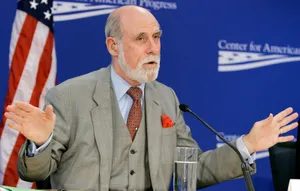
ARPANET had a major blind spot. It couldn’t talk to the other computing networks that sprang up in its wake. The design required too much control. Too much standardization. Machines and equipment had to play by the same rigid rules. That was a bottleneck. By the spring of 1973, Vinton Cerf and Bob Kahn were staring at a wall. They needed to connect ARPANET with two other emerging systems: SATNET, a satellite network, and ALOHANET, a packet radio system based in Hawaii.
The solution didn’t come in a lab. It came in a hotel lobby. Cerf was waiting. He dreamed up a new computer communications protocol. A gateway between networks. It eventually became known as the transmission-control protocol/Internet protocol (TCP/IP).
First tested on ARPANET in 1977, this wasn’t just a tweak. It was a handoff mechanism. One network could pass data packets to another. Then another. Then another. When the Internet eventually became a network of networks, this innovation was the only thing holding it together. It remains the basis of the modern Internet.
NCP to TCP/IP: The Great Switch
Why did this matter? Because the old guard wasn’t leaving quietly. In 1975, ARPANET moved to the Defense Communications Agency. It was no longer experimental. Nor was it alone. The late 1970s saw a surge of new networks.
- CSNET (Computer Science Research Network)
- CDnet (Canadian Network)
- BITNET (Because It’s Time Network)
- NSFNET (National Science Foundation Network)
NSFNET would eventually replace ARPANET as the backbone of the Internet. It was itself later superseded by commercial networks. But in 1983, the landscape was shifting violently.
The term “Internet” was adopted that year. It coincided with the wide use of TCP/IP. ARPANET was split. MILNET took over military and defense duties. A civilian version remained. The word “Internet” was initially coined simply as an easy way to refer to the combination of these two networks. Internetworking.
The end of ARPANET’s days began in mid-1982. Its original communications protocol, NCP, was turned off for a day. Only network sites that had switched to Cerf’s TCP/IP language could communicate. It was a forced migration. On January 1, 1983, NCP was consigned to history. TCP/IP rose as the universal protocol.
The UNIX Connection
The final breakthrough for TCP/IP came in 1985. It was built into a version of the UNIX operating system. This put it into Sun Microsystems workstations. Naughton notes that this placed it “into the heart of the operating system which drove most of the computers on which the Internet would eventually run.”
Cerf summarized it best. “The history of the Net is the history of protocols.”
As free and commercial online services like Prodigy, FidoNet, Usenet, and Gopher rose, ARPANET’s importance diminished. NSFNET became the backbone. The old system was finally shut down in 1989. Formally decommissioned in 1990.
Two years before Tim Berners-Lee would change everything again with the World Wide Web. The infrastructure was gone. The foundation remained.