




Modulation is the unsung hero of modern communication. Without it, your phone calls would be silence and your Wi-Fi would be a myth. In electronics, it is simply the technique of impressing information onto a radio-frequency carrier wave. You vary the wave’s characteristics—like amplitude, frequency, or phase—to match the data you want to send. Voice. Music. Data. Pictures. It all rides on that carrier.
There are many ways to do this. Each method alters a specific trait of the wave to encode the signal. The most common targets are amplitude, frequency, phase, pulse sequence, and pulse duration.
Analog Modulation Techniques
Analog modulation treats the carrier wave as a continuous stream. It does not use binary digits like digital methods. Instead, it works with the physical properties of the wave itself. The big three here are amplitude modulation, frequency modulation, and phase modulation.
Amplitude Modulation (AM)
Amplitude modulation is the oldest game in town. It impressed audio and visual info by varying the strength of the carrier wave to match the signal’s fluctuations. If the audio gets louder, the wave’s amplitude increases. If it gets quieter, the amplitude drops.
Commercial AM radio stations still operate between 540 and 1,700 kHz. They are spaced 10 kHz apart. Why does this matter? Because waves in this range bounce off the ionosphere. They get reflected back to Earth. This allows you to pick up stations hundreds of kilometers away, especially at night.
Beyond commercial radio, AM is used for long-distance shortwave broadcasts. It also carries the video portion of traditional television programs.
Frequency Modulation (FM)
Frequency modulation keeps the amplitude constant. It changes the frequency instead. The carrier’s frequency shifts up and down in direct response to the audio signal’s variations.
Edwin H. Armstrong, an American electrical engineer, developed FM in the early 1930s. His goal? Beat the noise. AM is highly susceptible to interference. Thunderstorms. Machinery. Random electrical currents. These disrupt the amplitude of a wave. Since FM relies on frequency, not amplitude, these noise sources leave the signal largely unchanged.
FM is also better suited for stereophonic sound. It handles high-fidelity audio for TV programs and long-distance telephone calls via microwave relays.
Where does FM broadcast? Higher frequencies than AM. Commercial FM stations occupy the 88 to 108 MHz range. They are spaced 200 kHz apart. That wide spacing allows for better clarity and less congestion.
Phase Modulation
Phase modulation varies the phase of the carrier wave. It responds to the vibrations of the sound source. It is often considered a cousin to FM.
Why? Because phase and frequency are linked. You cannot change one without affecting the other. The rate at which the phase changes is directly proportional to the audio signal’s frequency.
Phase modulation minimizes interference for broadcasts below 30 MHz. It is used alongside FM in some systems. Why not just use FM everywhere? FM struggles during signal amplification in broadcasting. Phase modulation steps in to handle that job. It also powers some microwave relays and is essential for Wi-Fi and satellite TV systems.
Digital Modulation Methods
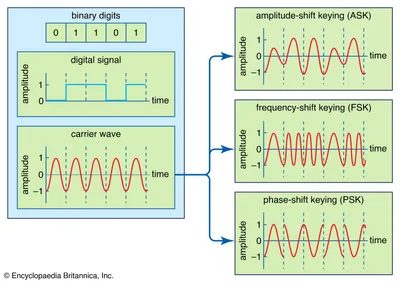
Computers speak in binary. To send that data over analog channels, we need to modulate the carrier wave to reflect those ones and zeros. We can tweak amplitude, frequency, or phase.
Amplitude-Shift Keying (ASK)
If you only change the amplitude, you are using amplitude-shift keying. It is the digital twin of analog AM.
In its simplest form, a radio frequency burst exists only when a binary 1 appears. A zero means the signal stops. Some variations use two specific amplitude levels to represent 0 and 1 instead of on/off.
Frequency-Shift Keying (FSK)
Change the frequency, and you get frequency-shift keying. Digital data is transmitted using two distinct frequencies. One frequency stands for a 1. The other stands for a 0. It is simple. It is robust.
Phase-Shift Keying (PSK)
Alter the phase, and you have phase-shift keying. The simplest version uses a single carrier frequency. A fixed phase represents a 0. A 180-degree phase shift (opposite polarity) represents a 1.
Digital modulation is not limited to these simple forms. Advanced techniques combine signals to pack more data into each shift.
Quadrature amplitude modulation (QAM) is a prime example. It superimposes multiple modulating signals. QAM transmits two amplitude-modulated signals that are 90 degrees out of phase. This allows four or more bits to be represented by each shift. It is how modern broadband and cellular networks achieve high speeds.
Pulse Modulation
Sometimes the carrier is not a continuous wave. It is a series of on-off pulses. This is pulse modulation.
Pulse-coded modulation (PCM) converts the signal into a series of constant-amplitude pulses. The spacing between these pulses encodes the information. PCM minimizes transmission losses. It eliminates noise and interference because the receiver only needs to detect simple pulse patterns.
Where do you see PCM? Digital audio. Computers. Compact discs. DVDs. Blu-Ray discs. It is the standard for high-quality digital storage and playback.
Another variant is pulse-duration modulation (PDM). Here, the intelligence lies in the length and order of regularly recurring pulses. It is less common than PCM but serves specific applications where timing precision matters more than amplitude.