




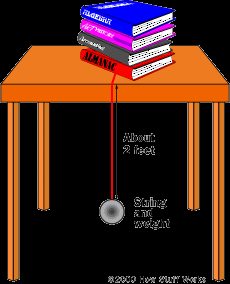
The period of a pendulum is determined by one variable only. Length.
That’s it. Mass, material, initial pull angle—none of it matters for the timing. You can prove this in ten minutes with household items.
Grab a weight. A coffee mug works. A hardcover book works. Tie a string to it. Suspend it over the edge of a table. Set the length to about two feet.
Pull the mass back a foot. Let it swing. Time it for 60 seconds. Count the swings.
Stop it. Restart it. This time, pull it back only six inches. Smaller arc.
Time it again. Count again. The number is identical. The angle of release does not change the period. Only the string length does.
Adjust the length until you hit exactly 60 swings per minute. You have a second pendulum.
This consistency made accurate timekeeping possible. Once engineers realized the physics held up, they built clocks around it. The escapement is the mechanism that translates that steady swing into movement.
A gear with specially shaped teeth sits near the pendulum. A device attached to the pendulum engages those teeth. Every back-and-forth swing allows one tooth to escape.
The gear moves. The hands advance. The time is recorded.
If you need precise calculation for the period, look up the standard formula. It involves gravity and length. But for the clock itself? The length is king.

Watch that pendulum swing left. It crosses the center. The left stop releases a tooth. The gear slides forward. Just half a tooth width. It hits the right stop.
Tick.
That is the heartbeat of mechanical timekeeping. The escapement gear makes a sound because it physically engages with a stop. This mechanism does more than just make noise. It controls the release of energy.
The Anchor and the Nudge
Pendulums do not swing forever. Friction exists. Air resistance exists. Gravity eventually wins unless you intervene.
The escapement’s secondary job is to push the pendulum. It gives it just enough energy to keep swinging. No more. No less. Too much energy throws off the timing. Too little and the clock stops.
This is where the anchor comes in. The anchor is the component attached to the pendulum. It interacts with the escapement gear. The teeth on the gear are not standard. They are specially shaped. This shape allows the gear to escape properly.
As the pendulum swings, the anchor nudges it. This nudge is the boost. It overcomes friction. The clock keeps moving.
The Problem with Direct Drive
Imagine you build an escapement with 60 teeth. You attach it directly to the weight drum. You use a pendulum with a one-second period.
You now have a clock. The second hand completes one revolution per minute. If you adjust the pendulum length with extreme care, accuracy is high.
High accuracy is useless if the clock is impractical. This design has two fatal flaws.
- No hour or minute hands. You only have a second hand.
- Constant winding. The drum makes one revolution every minute. The weight unwinds to the floor in 20 minutes.
Would you wind a clock every 20 minutes? Most people would not. It is a nuisance. It breaks the flow of daily life.
The Winding Conundrum
So, what does it take to solve the winding problem?
The answer requires changing the gear ratio. You need the weight drum to turn slower. You need the second hand to still move at one revolution per minute. This requires a series of intermediate gears. These gears multiply the rotation count.
The energy from the weight must travel through these gears before reaching the escapement. This slows down the descent of the weight. It extends the power reserve from 20 minutes to days or weeks.
But there is a catch. Adding gears introduces friction. It introduces error. The system becomes more complex. More parts mean more points of failure.
The engineer’s challenge is to balance efficiency with longevity. You cannot just add gears. You must add them correctly. The next step involves the gear train and how it transfers torque to the escapement. Without the right ratio, the clock either runs out of power too fast or runs too weakly to drive the hands.
The solution lies in the relationship between the mainspring barrel and the escape wheel.