


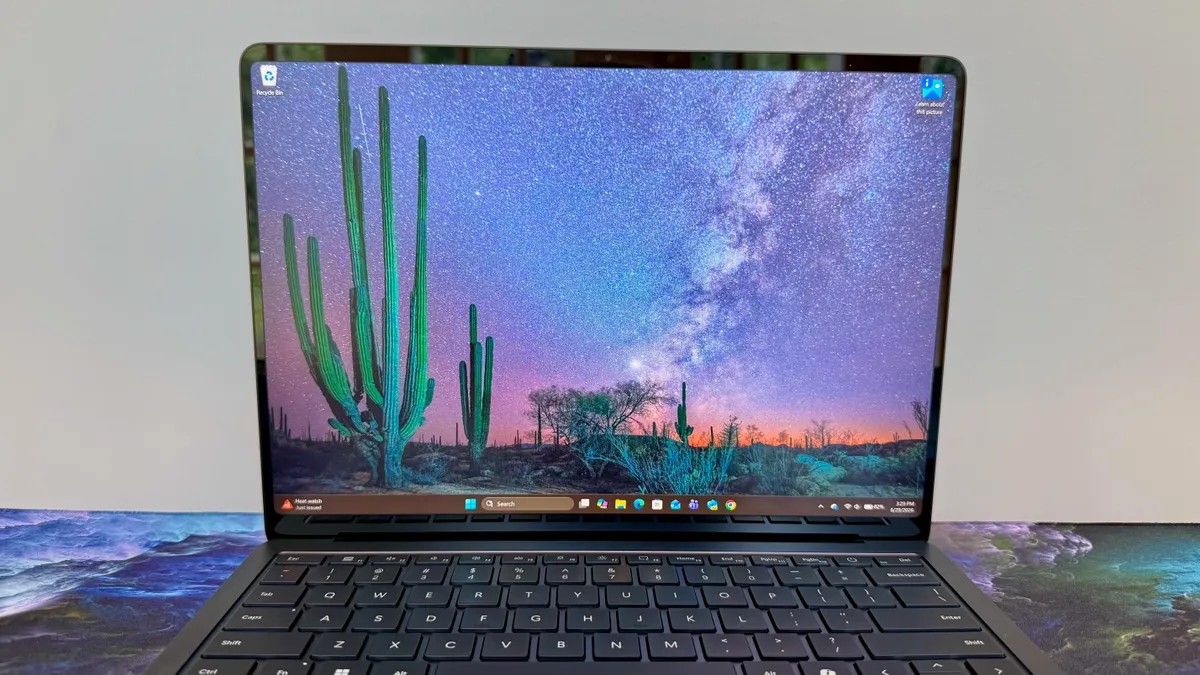
You need to love this laptop to ignore the price tag. I like the eighth-generation Microsoft Surface Laptop for Business. I really do. But the cost makes my stomach turn. It keeps me from falling in love. The Lenovo ThinkPad X1 Carbon still holds my heart. HP’s EliteBook Ultra is a close second. Those are still my top picks.
Let’s look at the machine itself. It comes in two sizes. Two processor families: Intel Core Ultra Series 3 and Qualcomm Snapdragon X2. I tested the 13.9-inch model with a Core Ultra 7 chip (often listed as X7 in early specs) and Intel Arc graphics (the B-series integrated chips). It’s strong overall. The battery life is decent, though not exceptional. The case is thin. It’s light, but not feather light.
The main draw here? The privacy screen. You can toggle it on with one key press. Nosy neighbors go dark.
It’s effective. Really. It narrows the horizontal view completely. The vertical view stays wide open. You sit directly in front and see everything perfectly. It’s a trick Lenovo’s Privacy Guard fails to pull off smoothly. HP doesn’t offer it at all.
That said, do you really spend your workday in crowded coffee shops or cramped airplane rows? If not, save your money. Buy a ThinkPad or an EliteBook. They often go on sale. They are better value for the majority of users.
Unlike the consumer versions, which lean hard into Snapdragon chips, the business model offers Intel too. But Intel is pricey. The Qualcomm models start at $1,650. The Intel series starts at $1.95k. For that near-two-thousand-dollar entry price, you get a Core Ultra 5, 16GB RAM, and 256GB storage.
Two-hundred-fifty-six gigs isn’t a lot for that kind of cash.
Want more space? Pay $100 for 512GB. Want 32GB of RAM? The prices spike. That specific Core Ultra 5 config with 32GB and 256GB hits $2,500. Add the SSD upgrade to 512GB? Now it’s $2,700.
Go for the stronger Core Ultra 7 (X7)? Starts at $2,55 for the 16GB/256GB setup. The model I reviewed—the one with 32GB RAM and 512GB storage—cost $3,300? Let’s round that to $3.3k. A staggering amount. Double the storage to 1TB? $3,70? Even for enterprise hardware, which carries a premium, this feels like robbery.
The integrated graphics help a bit. They are Intel’s best to date. But they still aren’t dedicated GPUs. With no dedicated video RAM, pushing these laptops into content-creation territory at $3,000+ feels wrong. You pay the premium, but you don’t get the horsepower.
The integrated privacy screen is only on the Core Ultra 7 models. The cheaper Core Ultra 5 versions get the same 13.9-inch screen otherwise: 3:2 aspect ratio, 2304×1536 resolution, 120Hz touch. But no privacy toggle.
In the UK, this starts around £1,82. In Australia, look for AU$3,29.
Performance checks out
The Core Ultra 7 CPU paired with 32GB of RAM runs well. Lab tests confirm this. The 16 cores shine in multi-core tasks. Geekbench 6 and Cineben204 results are solid. They aren’t the best. The HP OmniBook Ultra14 and Yoga Slim7x (with their 18-core Snapdragons) edge out the scores slightly in both single and multi-core performance.
Where does the Surface win? 3D tests. Among laptops with integrated graphics, it is currently hard to beat the Intel B-series. Its 12 Xe-core GPU crushes the Snapdragon rivals in 3DMark Steel Nmaad.
It’s playable, actually.
It hit 60fps in Guardians of the Galaxy at 10p.
61fps in Shadow of the Tomb Raider.
Again, this isn’t a gaming laptop. It’s not built for that. But for demanding graphics tasks? It doesn’t choke.
The battery situation? Less impressive. Those Snapdragon competitors lasted over 20 hours in our YouTube stream test. The Surface Laptop failed to hit 15 hours. Microsoft claims 23 hours, sure. But that’s for local video playback, not streaming. And that quote probably applies to the lower-power Core Ultra5 chip anyway.
A repairable box
You get it in Platinum or Black. I had the black. The matte finish and minimal lines give it a vibe reminiscent of Razer gaming gear, if Razer decided to make a serious business machine.
Gone is the 5G option from previous generations. Sad for road warriors who need cellular fallback when Wi-Fi dies. What you gain, though, is an all-aluminum shell. The last-gen plastic keyboard deck was only there to boost cell signals. No signal needs mean pure metal now.
The build quality is high. At 0.7 inches, it is impressively thin. No flex anywhere. The frame is rigid. The weight? 2.9 pounds. Average, really. It’s nowhere near the featherlight 2.2-lb ThinkPad X1 or the 2.6-lb EliteBook Ultra. It feels premium. It should. You paid for it.
Microsoft has done something rare lately. They made it repairable.
You can replace the SSD, keyboard, touchpad, and battery. Opening the machine is straightforward. Pop off four rubber feet on the underside. Remove four Torx screws. Done. The bottom panel is off in five minutes, maybe two of those minutes spent figuring out how to pry off the rubber feet.
Microsoft advises a “skilled technician.” I see why. There isn’t an obvious slot for the SSD removal without potentially damaging the motherboard traces. The battery comes out easily enough. But here’s the kicker: RAM is soldered. Once you buy the RAM capacity, it’s yours for the life of the device. No expanding it later.
The screen you actually look at
The display is special in three ways.
- It has a 3:2 ratio. Taller than a typical 16:10. Good for reading documents and coding. More vertical space. You sacrifice a little bit of width, which means more letterbox bars when watching widescreen movies. A small price.
- The antiglare finish is top-tier. It cuts down the distracting reflections without washing out the colors or making the image look muddy. It’s bright, too. My tests hit a peak of 22 nits. Wide color coverage as well—100% sRGB and 99% P3.
- The privacy mode works.
Hit F1. The brightness drops just enough to matter, and suddenly only you can see the screen. Someone next to you? Nothing. The horizontal angle restricts heavily. The vertical angle? Unchanged. I don’t have to hold my head stiff as a board to read my own screen anymore. Most privacy screens are annoying to look through. They dim things too much or crush your vertical FOV so much that moving your head blinks the content out of view. This implementation? The best I’ve tested.
What about the input devices? The keyboard title still belongs to the Lenovo ThinkPads, easily. Their keys have travel. They feel plush and sculpted. The Surface keys? Flat. Shallow. Firm response. They are fine. Functional. But they lack that joy. The haptic trackpad, though? Fantastic. Smooth. Click feels consistent and precise no matter where you tap.
The 10p webcam? Disappointing for a business device used daily for video calls. The image isn’t as crisp or clear as the higher-res shooter on the EliteBook Ultra G1. You get an IR sensor, so facial recognition for Windows Hello login works smoothly. Secure. Easy.
But there’s no fingerprint reader. Face ID is your only biometric bet. If your face looks bad one morning? Good luck logging in.
Ports are sparse, but functional. On the left side: two Thunderbolt4 (USB-C) ports. One USB-A port. A headphone jack. On the right side? The Surface Connect charger port. This is nice. It means one USB-C port isn’t blocked by a cable while working. And because it’s magnetic? Pull the laptop if you trip? The cable snaps off before the computer does. You drop nothing. That saves laptops lives.
Verdict
Should you buy it?
Only if the privacy screen is essential for you. Do you carry sensitive data around airports? Constantly work in public? Then this screen tech is worth the pain. Microsoft nailed this feature. Best in class, easily.
If you don’t need it?
Skip it. Look at the Lenovo ThinkPad X1. Or the HP EliteBook Ula G1. Both are lighter. Both offer fuller features. Both often drop hundreds of dollars during sales. You can track these deals easily.
The Surface Laptop for Business price hasn’t moved a single cent since I started tracking it. It sits there. High and mighty.