




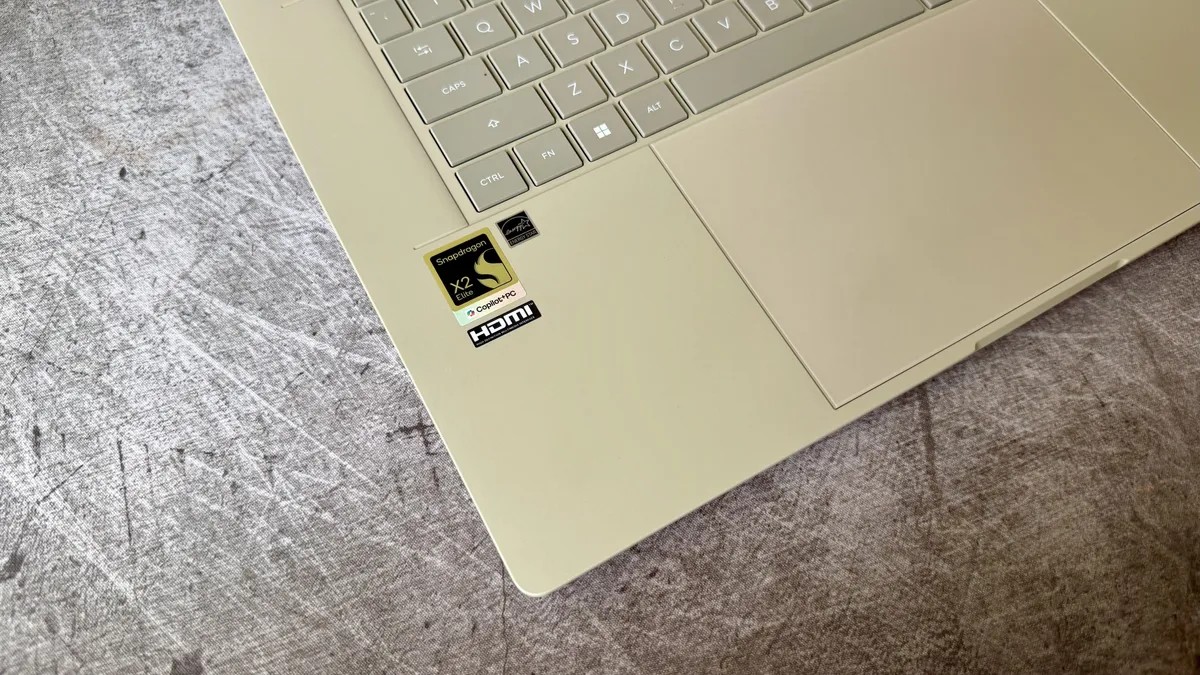
While “AI laptop” has become a ubiquitous marketing buzzword, actual consumer demand remains specialized. Most buyers prioritize battery life, screen quality, and portability over neural processing capabilities. However, for the segment of users looking to leverage on-device intelligence, the Asus Zenbook A16 is not just a marketing gimmick—it is a genuine leader in the field.
Powered by the Qualcomm Snapdragon X2 Elite Extreme processor, this machine delivers industry-leading AI performance while maintaining a remarkably lightweight profile for a 16-inch device.
Performance: Leading in AI, Lagging in Graphics
The heart of the Zenbook A16 is its 18-core CPU and a Neural Processing Unit (NPU) capable of 80 trillion operations per second (TOPS). This architecture places it ahead of many competitors in specific categories:
- AI Supremacy: In Geekbench AI testing, the Zenbook A16 scored 85,328, significantly outpacing both the Apple M5 MacBook Pro and Intel-based “Panther Lake” laptops.
- Multicore Efficiency: In high-intensity tasks like Cinebench 2024, the Snapdragon X2 Elite Extreme rivaled and even surpassed the MacBook Pro in multicore performance.
- The Achilles’ Heel (Gaming): While the AI and CPU performance are top-tier, the integrated Qualcomm Adreno graphics struggle compared to Intel’s offerings. In 3D benchmarks, the Zenbook A16 delivers roughly half the frame rates of Intel-based competitors, making it a poor choice for gamers.
Note on Compatibility: Because this laptop runs on Windows-on-Arm, users should verify that their specific software is compatible with the Arm architecture before purchasing.
Design: The Magic of “Ceraluminum”
Asus has addressed the common problem of “flex” in large, thin laptops through its proprietary Ceraluminum material. This aluminum alloy with a ceramic-like finish provides a rigid, premium feel without the weight penalty.
The result is a feat of engineering: the Zenbook A16 weighs just 2.9 pounds. To put that in perspective, it is significantly lighter than a 16-inch MacBook Pro (4.7 lbs) and even lighter than the much smaller 15-inch MacBook Air (3.3 lbs).
Design Trade-offs
Despite its structural triumphs, the device has a few notable drawbacks:
– Mechanical Touchpad: At a $1,700 price point, the lack of a haptic touchpad—which provides consistent, customizable click feedback—is a missed opportunity.
– Aesthetic Choices: The “beige” color option may not appeal to everyone, though it offers a departure from the standard gray palette.
– Biometrics: While it includes an IR sensor for Windows Hello, it lacks a fingerprint reader.
Visuals and Multimedia
The centerpiece of the user experience is the 16-inch 3K OLED display.
– Quality: With 100% coverage of the sRGB and P3 color gamuts, the screen is exceptionally color-accurate, making it a strong candidate for creative professionals.
– Brightness: Reaching nearly 500 nits, it offers deep blacks and vivid contrast that outshines many standard LCD panels.
– Audio: The six-speaker array provides a much fuller soundstage than previous 14-inch models, though bass remains relatively light.
Connectivity and Value
For creators, the inclusion of a full-size SD card slot is a major plus, alongside USB4, USB-A, and HDMI ports. However, the price tag is steep. The $1,700 model comes with a generous 48GB of RAM, which helps justify the cost in an era of high memory prices, but the lack of an expandable second M.2 slot for storage may frustrate power users.
Conclusion
The Asus Zenbook A16 is a masterclass in balancing a large-format productivity machine with extreme portability. While it is not a gaming rig, its unrivaled AI processing and stunning OLED display make it a premier choice for professionals who need power, intelligence, and a lightweight design.