




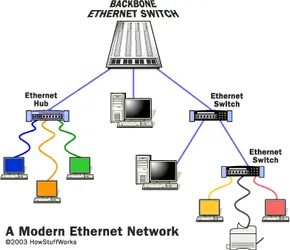
Modern Ethernet is not like the messy coaxial hubs of the past. Traditional installations are based on long-distance shared cables, where all devices compete for bandwidth. Today’s infrastructure uses radial twisted pair or optical fiber. Speeds vary from a slow 10 Mbps to 100 Mbps and up to 1000 Mbps.
The real game changer is Switched Ethernet.
Replacing the Shared Medium
旧的网络就像一条派对线。 每个人都听到了一切。 如果你说话,每个人都会听。 交换以太网通过为每个站提供一个专用网段来解决这个问题。
Think of the switch as一个super-powered bridge。 它同时连接数百个这样的单站网段。 由于交换机和设备之间的链路仅包含两个节点,因此交换机会捕获每次传输。 它不会广播到整个房间。 它仅将帧转发到接收者所在的特定端口。
这种隔离至关重要。
交换网络允许多个对话同时进行而不会发生冲突。
Why It Matters for Speed and Efficiency
With traditional Ethernet, data collisions slow everything down. If two devices are talking at the same time, the signal will collapse. They had to wait and try again. Switched Ethernet removes this bottleneck. Each network segment is private, so you’re not sharing a line with 20 other computers.
The switch acts as a traffic controller. It learns which MAC address is on which port. When the data arrives, it checks its destination and sends it to the right door. No noise. There are no distractions. Clean and direct delivery only.
This architecture supports high-density connections. One switch can handle hundreds of devices, each with its own channel. The result is a network that can scale efficiently. It can handle heavy traffic loads without the performance degradation seen in older hub-based systems.
The Technical Shift
从同轴总线拓扑到交换星型拓扑的转变改变了一切。
- 传统以太网 :共享介质。 高碰撞率。 较低的速度。
- 交换以太网 :专用网段。 全双工通信。 更高的速度。
You get全双工,因为交换机可以同时在同一链路上发送和接收。 不再有半双工限制。
这不仅使文件传输速度更快。 它减少了延迟。 它提高了可靠性。 对于日常用户来说,这意味着更流畅的视频通话和更快的网页浏览。 基础设施在后台默默运行,确保您的数据通过最短、最清晰的路径到达目的地。
硬件已经发展。 逻辑已经清晰了。 但核心目标仍然相同:尽可能快地将数据包从 A 移动到 B。 交换机让大规模实现这一目标成为可能。
when the switch fails时会发生什么? 网段变暗。 冗余成为下一个优先事项。 但就目前而言,交换架构是现代局域网的支柱。