



It moved fast. That’s the only way to describe Napster’s rise. In less than twelve months, the site exploded from zero to 60 million monthly visitors. It wasn’t just popular. It was the most visited website on the internet at its peak. Then the courts stepped in. A single order shut it down due to rampant copyright violations. It didn’t see the light of day again until 2003, rebranded as a legal, pay-for-music service under Roxio.
The appeal was simple. You got free music. You didn’t have to drive to a store. You didn’t have to buy a CD, pop it in, and wait for the rip. You just clicked. A massive database held nearly every song in existence. It was effortless. It was free.
But that ease came at a cost. The architecture was the fatal flaw.
Napster relied on a central server to index and connect users. This centralized model made it easy to find music, but it also made it easy to kill. When judges ruled that Napster was facilitating copyright infringement, the shutdown was surgical. Pull the plug on the server, and the whole network vanished. There was no backup. No decentralized fallback. Just silence.
Users didn’t care about the legal nuance. They cared about access. Most migrated to a different kind of file-sharing system. One that couldn’t be killed so easily.
The Rise of Gnutella
Enter Gnutella.
This was the alternative. It wasn’t just a tool; it was a different philosophy. Instead of a central hub, Gnutella used a peer-to-peer (P2P) network. Every computer in the network was both a server and a client. There was no single point of failure. To shut it down, you’d have to shut down every individual user’s computer.
This decentralized architecture is why Gnutella survived. Even as courts cracked down on other services, Gnutella persisted. It adapted. It evolved. It became the backbone for many modern P2P protocols.
The original Napster was a store with no locks. Gnutella was a maze with no center. One was easy to rob. The other was hard to catch.
The New Napster
By 2003, the landscape had changed. Roxio bought the Napster name and relaunched it. Version 2 was legal. You paid for your music. No more infringement. It was a cleaner product. Safer. But it lacked the raw, chaotic energy of the original. The magic wasn’t just in the music. It was in the freedom.
The old Napster taught us something. Centralization is efficient until it’s not. Decentralization is messy, but it’s resilient. We learned that the hard way.
Now, every time you stream a song, you’re paying for convenience. You’re using a centralized service. Spotify. Apple Music. YouTube Music. They’re easy to use. They’re safe. They’re also vulnerable. One company controls the library. One company controls the access.
Gnutella showed us another way. A way where the network is the product. Where the users are the infrastructure. It’s slower. It’s more complex. But it’s free from a single point of control.
Which
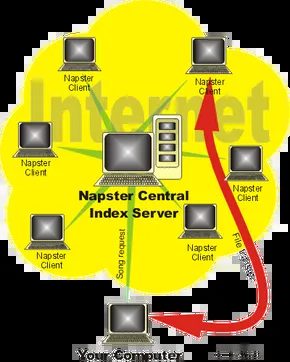

Standard web browsing is a simple transaction. You ask a server for a file, and the server sends it back. For massive sites, this requires hundreds of machines just to keep the lights on. Napster broke this model entirely. It didn’t just host files; it turned every user’s computer into a node in a massive, decentralized distribution network.
The original Napster was a hybrid system. It used peer-to-peer file sharing for the actual data transfer, but it relied on a central authority for discovery. When you launched the software, your machine registered with Napster’s central servers. You were essentially listing your available MP3s in a global catalog.
Here is the workflow:
- You installed the client. Your PC became a mini-server.
- Your machine pinged the central servers, submitting a list of every track on your hard drive.
- The central database now held the index for billions of songs.
- You searched for “Roxanne” by The Police.
- The central server returned a list of IP addresses for users hosting that file.
- You selected a peer. Your computer connected directly to theirs and downloaded the song.
This architecture solved two immediate problems. First, storage. No single company could buy enough hard drive space to hold the entire world’s music catalog. Second, bandwidth. Distributing the load across millions of home connections was infinitely cheaper than streaming from a data center.
There was also a legal strategy involved. The creators argued they were exploiting a loophole in copyright law regarding private sharing among friends. The courts eventually rejected this logic. But the damage was done. The concept was proven. The network had grown too large to ignore.
The flaw in Napster’s design was obvious in hindsight. The central database was a single point of failure. It was the Achilles’ heel. When the court ordered the shutdown, the entire network collapsed. You couldn’t have a peer-to-peer network if the index for it was owned by one entity that could be legally silenced.
By the time Napster fell, there were roughly 100 million users accustomed to sharing files freely. The infrastructure for that behavior was already in place. Waiting in the wings was a more resilient architecture.
Why Gnutella Changed the Game
The successor to this wave of file sharing is the Gnutella network. It keeps the core mechanic of peer-to-peer file sharing but removes the central hub. Users still place files on their hard disks and make them available. You still need Gnutella software to connect to the network.
The differences are structural and significant.
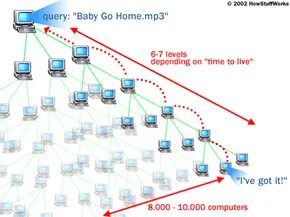
First, there is no central database. The concept of a global index is dead. Instead, Gnutella uses a distributed query approach. When a user searches for a file, the request is passed from node to node, hopping across the network until it finds a match. It is a ripple effect of queries.
Second, the ecosystem is fragmented. There is no single “Gnutella client.” Many different applications can access the Gnutella network. This variety makes it harder to target a specific piece of software for legal action.
This decentralization offers a degree of immortality that Napster never had. A court order against one company does nothing to stop the protocol. To actually shut down Gnutella, regulators would need to block all network traffic at the ISP level or the backbone infrastructure. That is a technical and political nightmare compared to simply suing the CEO of a centralized server company.
The shift from a centralized index to a distributed query system wasn’t just a technical upgrade. It was a response to the fragility of the old model.

Napster relied on a single, fragile piece of client software. Gnutella didn’t have that luxury, or rather, it had too much of it. The network fractured into dozens of competing applications. You could choose BearShare, Gnucleus, LimeWire, Morpheus, WinMX, or XoloX. The interface might look different, but the underlying logic was identical: kill the central authority.
But without a central index, the network needs a way to find things. This is where the Gnutella client search mechanism diverges sharply from the traditional server-client model.
How Gnutella Clients Locate Files
Imagine you want a specific MP3. There is no library to check. Instead, your software has to shout into the void.
It starts with a single point of contact. You might have manually entered an IP address, or the software came pre-loaded with a list of known hosts. Your machine sends the search query to that neighbor.
The neighbor doesn’t just answer. It checks its own hard drive. If the file is there, it sends back the filename and your IP. But it also does something more aggressive. It forwards your request to every other machine it knows.
Those machines do the same. They check their storage. They forward the request further. This creates a ripple effect, a wave of queries expanding outward through the network.
The system relies on a Time To Live (TTL) counter to prevent infinite loops.
Each request has a TTL limit. Think of it as a fuel gauge. The request might travel six or seven “hops” deep before it runs out of gas. If each node knows just four other peers, a seven-level deep search can theoretically touch 8,000 machines.
It is brute force distributed computing. Simple. Clever. And exhausting.
The Trade-Off: Stability vs. Performance
This architecture solves the biggest problem of its predecessor. Napster died because one server owned the keys. Gnutella has no keys. There is no single point of failure. No court order can kill the network because there is no head to cut off. Gnutella works all the time, provided you can reach at least one other peer.
But decentralization comes with a tax.
First, there is no guarantee the file exists. You could blast your query to 8,000 machines and get zero hits. The file might be on machine 8,001. You are blind.
Second, latency is brutal. Since the query has to propagate through multiple layers, you might wait a minute or more for a complete response. The system doesn’t tell you what it found until it has checked as far as it can go.
Third, you are the infrastructure. Your machine isn’t just a consumer; it is a router. It answers incoming requests and passes outgoing ones along. You are burning your own bandwidth to keep the network alive. It is a peer-to-peer system in the literal sense: you are helping the other peers, often at your own expense.
These disadvantages seem severe in theory. In practice, users didn’t care. Hundreds of millions of copies of Gnutella clients have been downloaded. The promise of access outweighed the cost of bandwidth.
XoloX Example: Searching
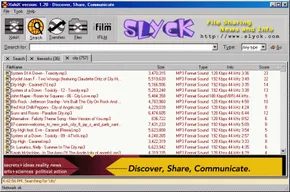

XoloX is about as bare-bones as it gets for a Gnutella client. It doesn’t try to dazzle you with flashy interfaces or complex features. It just works. The download is tiny—around 600 kilobytes—and crucially, it’s clean. No spyware. No bundled pop-ups. Just a straightforward tool that’s easy to install, which makes it an ideal candidate for understanding the mechanics of peer-to-peer networking without the bloat.
The interface boils down to three core functions, accessible via three buttons at the top of the window: search, transfer, and file management. You toggle between them as needed.
How Gnutella Search Works in XoloX
When you open the search tab, it’s almost too simple. Type a filename or a few keywords. You can filter by media type—audio, video, or “All Types”—if you want to narrow the scope. Hit enter, and the client broadcasts your query into the void.
Give it 30 to 60 seconds.
The search window begins to populate. Results trickle in from thousands of other machines processing the same request. It’s not instantaneous, but it’s effective.
You’ll notice a column labeled score. This isn’t a rating of file quality. It’s a count of how many online peers currently have that specific file available. A high score means more sources. More sources mean better odds of actually completing the download, especially if you’re dealing with a popular file. Choose wisely.
XoloX Example: Downloading


Getting a file off a peer network isn’t always a click-and-wait simple affair, but XoloX makes it mostly painless. You just double-click the target in your search results. That action passes the filename to the Transfer window, which triggers the actual handshake with the peer.
Here is where the protocol shines. If multiple nodes in the network hold that same file, XoloX doesn’t pick one at random. It connects to several simultaneously. This parallel download strategy is why you might see speeds like 69.2 kilobytes per second for a large video file, with estimates hovering around 43 minutes for over 100 megabytes. It’s leveraging redundancy to beat the bottleneck.
But it’s not always this smooth.
Sometimes you click and… nothing happens. The client can’t reach the source, or the host machine is already maxed out serving other users. This is the classic peer-to-peer traffic jam. You have three ways to handle it:
- Wait it out. Busy nodes eventually free up. Patience is a valid strategy here.
- Choose high-score files. Files with better reputation scores are more likely to come from responsive, available peers.
- Swap the file. Delete the stuck download from the Transfer window and pick the same filename again from the search results. This forces the client to try a different peer that might be less congested.
Once the download finishes, the data lands in your designated XoloX directory. You can also view it in the Files window within the app. If you want to give back to the network, you can share these downloaded files. This isn’t automatic, though. You need to configure the Preferences dialog to specify exactly which directories and file types you are willing to share with others.
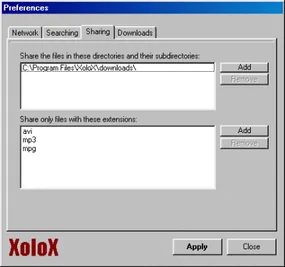

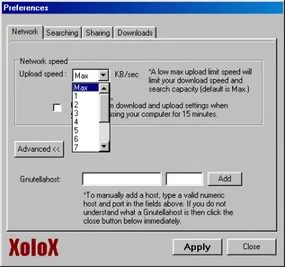
You have control over the drain on your connection. By adjusting XoloX settings, you can cap the outgoing bandwidth it uses when others download from your machine. This simple toggle stops your upstream pipe from getting choked out by other people’s data requests.
Is Gnutella actually legal?
The protocol itself is clean. There is no statute that bans the sharing of public domain files. The illegality emerges only when users deploy the network to distribute copyrighted music and films. That specific friction is what sank Napster.
The music industry has officially declared war on Gnutella. Yet, they lack a straightforward mechanism to stop it.
How the industry tries to break the network
Disrupting the architecture is the current strategy. Two main attacks are currently in play:
- Flooding the network with bogus search packets to overload it.
- Populating Gnutella servers with corrupted files that serve no purpose.
But the developers behind Gnutella have survived similar threats before. They are likely to patch these holes. The software will adapt. The files will keep flowing.
Is sharing just theft or free advertising?
The real debate isn’t technical. It’s financial. How much actual damage does file-sharing cause? Is a shared file a theft, or is it free advertising? Think of it like radio airtime. Does exposure hurt sales or help them?
Frequently Asked Questions
What is the Gnutella protocol?
It is a peer-to-peer (P2P) file-sharing protocol. It lets users search for and swap files directly with other computers, without a central server holding the inventory.
More Resources
If you want to dig deeper into the legality debates or see different perspectives on copyrighted music sharing, the links below offer more context.
Related Articles
- How MP3 Files Work
- How MP3 Players Work
- How Napster Worked
- How Web Servers Work
- How Hard Disks Work
- How CD Burners Work
- How Internet Infrastructure Works
- How Home Networking Works
- What are copyrights and patents?
Useful Links
- Gnutella Host Directories
- Kazaa
- Knowbuddy’s Gnutella FAQ
- Gnutella News
- PHP Gnutella search code
- The Internet Debacle – An Alternative View
- Embedded.com: Embedding Peer-To-Peer
Recent News Headlines
- MTV.com: Recording Industry Sues 32 Students For Illegal File-Sharing – 10/04
- New Wave of Illegal File Sharing Lawsuits Brought By RIAA – 4/04
- Tom’s Hardware Guide: Survey: Music file sharing on the decrease – 4/04
- WiredNews: Roxio Buys Pressplay, Napster Lives – 5/03
- NewScientist.com: “Random walkers” may speed peer-to-peer networks – 7/02
- Gnutella.com: Labels Planning Legal Attack on Individuals? – 7/02
- Gnutella.com: Hollywood Wants to Plug the “Analog Hole” – 5/02
- P2P.com: Gnutella and Freenet Represent True Technological Innovation – 5/00


