



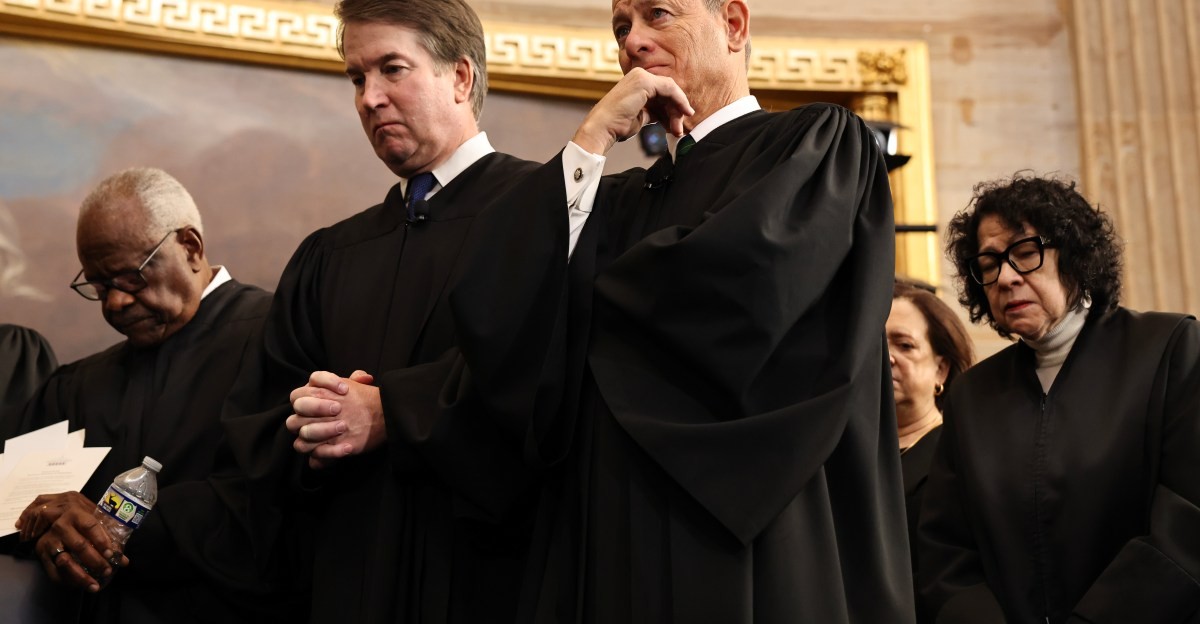
The Supreme Court issued a rare rebuke to former President Donald Trump on Tuesday, ruling that he violated federal law by deploying National Guard troops against a small protest outside an immigration detention facility in Broadview, Illinois. The 6-3 decision, with three Republican-appointed justices joining the Democratic minority, marks a significant constraint on presidential authority, though it does not fully resolve concerns about future abuses of power.
The Case and the Ruling
The dispute stemmed from Trump’s attempt to invoke federal law allowing the federal government to take control of state National Guard units during a “rebellion” or when the president deems regular military forces insufficient to enforce laws. Trump claimed that protesters—typically numbering fewer than fifty—posed such a threat, justifying military intervention. The Court rejected this argument, focusing on whether Trump was genuinely “unable” to enforce laws without the Guard.
The Court’s decision essentially clarifies that the president cannot deploy the National Guard unless unable to utilize the full might of the U.S. military—Army, Navy, Air Force, and Marines—to enforce federal law. This is a notable limitation because it forces Trump to prove a genuine inability to act without the Guard, rather than simply claiming that inability.
Potential Future Conflicts
While the ruling is a win for limiting presidential overreach, it doesn’t eliminate all risks. The Court’s language could inadvertently encourage Trump to attempt deploying regular military forces against protesters, forcing further legal challenges.
Furthermore, the ruling does not address the Insurrection Act, which allows military intervention in cases of domestic unrest. The Justice Department historically interpreted this act narrowly, requiring proof of either state approval for violence or effective control of an area by insurgents—like the Ku Klux Klan in the 1870s. It remains to be seen whether the Court will uphold this narrow interpretation if Trump attempts to invoke the Insurrection Act.
Dissenting Opinions
The conservative Justices Alito and Gorsuch dissented. Alito argued Trump should have broad authority to deploy military force simply by stating that regular forces are “insufficient.” This position was supported only by Justice Thomas, underscoring the deep ideological split on presidential power within the Court.
Why This Matters
This case is more than just a legal dispute: it’s a battle over the limits of presidential authority in a democratic society. The fact that three Republican-appointed justices joined the majority suggests a growing unease even within conservative circles about unchecked executive power. The precedent set by this decision could prevent future presidents from militarizing domestic protests under flimsy pretenses, but the issue remains far from settled.
The Supreme Court’s decision sends a clear message: even a president cannot deploy the military against American citizens without a legitimate legal basis. However, the ongoing potential for conflict over the Insurrection Act and the willingness of some justices to grant broad executive power mean this will likely remain a contested issue for years to come.