



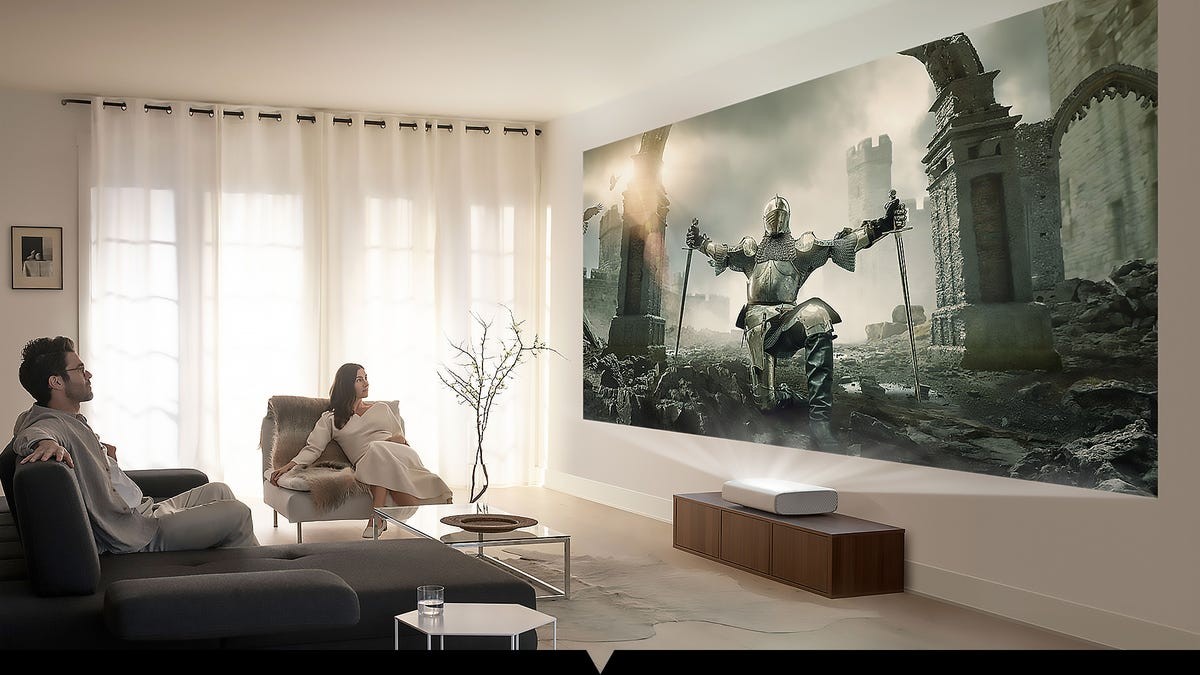
Ultrashort-throw (UST) projectors, often marketed as “laser TVs,” are gaining popularity for their ability to create massive images in small spaces. Unlike traditional projectors that require significant distance from the screen, UST models sit inches away from the wall, projecting upward to fill a large viewing area. While their technical specs – particularly brightness – often seem impressive, a closer look reveals significant trade-offs in image quality and value.
The Appeal and the Reality
UST projectors excel where traditional setups struggle: tight spaces where a long throw distance is impractical. They boast high lumen ratings, creating bright images even in moderately lit rooms. However, the marketing promise of a seamless “TV replacement” often overlooks critical compromises. UST projectors practically require a specialized screen to perform optimally, and their image quality doesn’t always match their price tag.
How UST Technology Works
Conventional projectors can create a 100-inch image from around 10 feet away. Short-throw projectors reduce this to about 5 feet, while USTs achieve the same size from under a foot. This is accomplished through highly complex lens systems.
Many UST models utilize laser light sources and 4K imaging chips, leading to high brightness (measured in lumens). However, brightness alone doesn’t guarantee a superior viewing experience. The true determinant of picture quality is contrast ratio – the difference between the darkest and brightest parts of an image. While UST projectors can boast impressive lumen counts, their elaborate lenses often reduce contrast compared to cheaper, non-UST alternatives.
The Hidden Costs
The perceived simplicity of UST installation is another area where expectations diverge from reality. While technically true that they can be placed directly in front of a wall, optimal placement requires precise furniture height. A 100-inch image requires roughly 4 feet of vertical space, plus the projector’s own height (around 6 inches), meaning the supporting cabinet must be around 3 feet tall to avoid the image clipping into the ceiling.
Beyond the projector itself, the cost of a dedicated screen is often overlooked. UST projectors perform poorly without a specialized screen designed to redirect light effectively. Ambient light-rejecting (ALR) and ceiling light-rejecting (CLR) screens are often necessary to maximize brightness and contrast, adding hundreds or even thousands of dollars to the overall cost.
The Pros: Where USTs Shine
Despite the drawbacks, UST projectors offer unique advantages:
- Space Optimization: Ideal for small rooms or situations where traditional projector placement is impossible.
- High Brightness: Many models deliver exceptionally bright images, though often at the expense of contrast.
- Integrated Audio: Some USTs feature better built-in speakers than standard projectors, reducing the need for external sound systems.
The Verdict: Are They Worth the Investment?
While UST projectors solve certain problems – particularly space constraints – they come at a significant premium. For the same price (or less), you can often achieve better overall image quality with a traditional projector or a high-end television. The promise of effortless installation is also overstated, as optimal performance requires careful setup and a dedicated screen.
If you prioritize convenience and have limited space, a UST projector might be a viable option. However, if image quality and value are your primary concerns, a traditional projector or a large-screen TV remains the more sensible choice.
Ultimately, the decision depends on your specific needs and budget. But buyers should approach UST marketing with healthy skepticism, understanding that the reality rarely matches the hype.


