



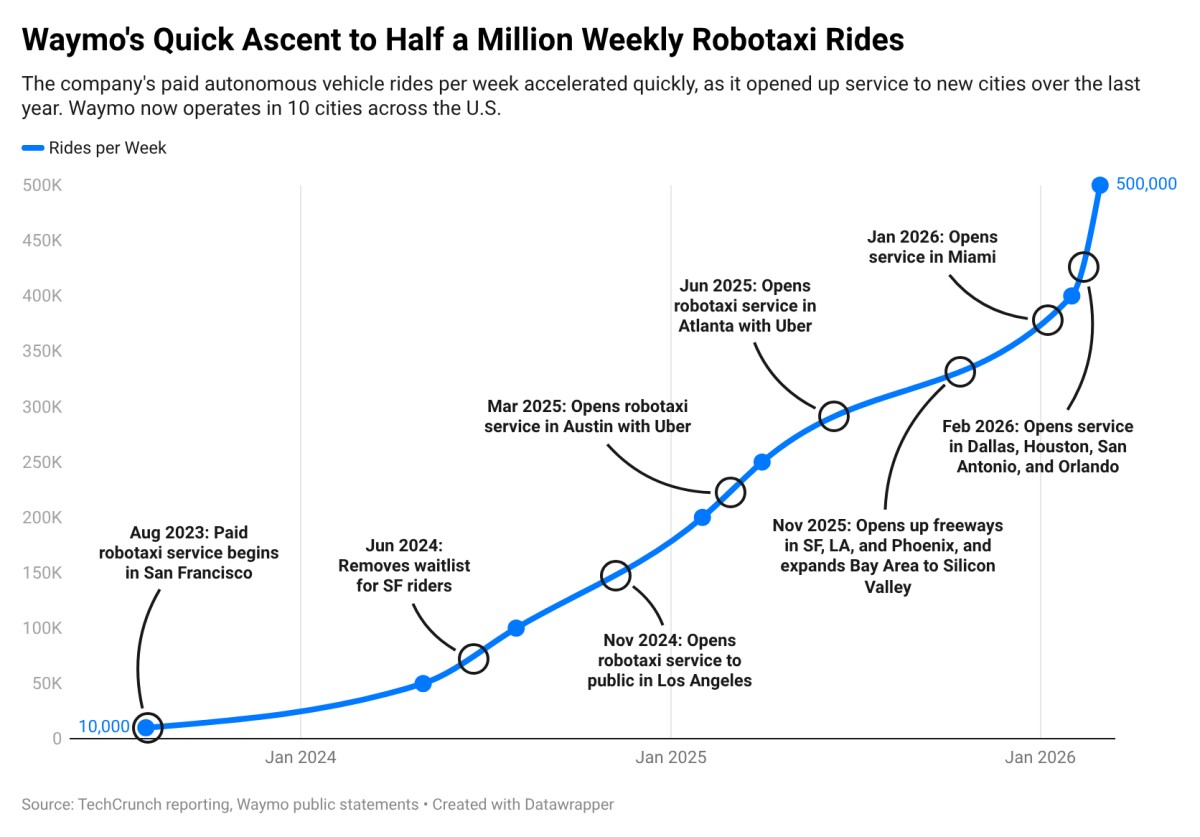
Waymo, Alphabet’s autonomous vehicle division, is now completing 500,000 paid robotaxi rides per week across ten U.S. cities. This milestone represents a dramatic increase in commercial operations, but more importantly, it highlights the accelerating pace of self-driving technology adoption.
Exponential Ridership Growth
In just under two years, Waymo’s weekly paid trips have increased tenfold, jumping from 50,000 in May 2024 to the current 500,000. This expansion isn’t limited to initial markets like Phoenix, San Francisco, and Los Angeles; the company has aggressively moved into the Sun Belt, adding Austin, Atlanta, Miami, Dallas, Houston, San Antonio, and Orlando within the past year. This rapid market penetration shows Waymo’s ability to scale operations quickly.
Fleet Optimization
Waymo maintains a fleet of “over 3,000” self-driving vehicles equipped with its 5th-generation system (as of December 2025). The relatively stable fleet size paired with the tenfold ridership increase suggests greater efficiency – Waymo is maximizing the utilization of each vehicle. This is critical because idle robotaxis add congestion without generating revenue. The upcoming 6th generation system, debuting on the Zeekr Ojai and Hyundai Ioniq 5, could further enhance this optimization.
Regulatory and Public Scrutiny
Despite the growth, Waymo faces growing scrutiny. Investigations by the National Highway Traffic Safety Administration (NHTSA) and the National Transportation Safety Board (NTSB) are underway regarding incidents involving Waymo vehicles and school buses. Local officials in San Francisco have also raised concerns about how the company handles disabled vehicles, sometimes relying on emergency services to clear them. These challenges demonstrate the real-world complexity of deploying fully autonomous systems.
Context: Waymo vs. Uber
While impressive, Waymo’s ridership is still a small fraction of Uber’s global ride-hailing business, which completed 13.5 billion trips in 2025. Uber completes over a million mobility trips per hour. However, Waymo is rapidly closing the gap in the autonomous space.
The Competitive Landscape
Several companies are pursuing robotaxi services, but few have launched fully autonomous, paid programs. Chinese firms like Pony.ai and WeRide offer paid rides, but not in the U.S. Tesla recently began a paid service in Austin, though it lacks necessary permits for wider deployment. Other contenders include Avride, Motional (Hyundai-owned), and Zoox – all aiming for paid services by year-end. Waymo currently holds a significant lead in this emerging market.
Waymo’s growth is more than just numbers; it signals a shift in how transportation could evolve, forcing competitors to adapt or fall behind. The key now is not just technological advancement, but also navigating public trust and regulatory hurdles.