














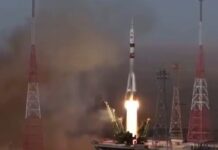


Russia has sustained critical damage to its primary and, currently, only launch facility for crewed missions, the Baikonur Cosmodrome in Kazakhstan. This incident marks the first time since 1961 that Russia lacks immediate independent access to launching astronauts into space.
Launch Success, Ground Failure
Despite a successful launch of the Soyuz MS-28 spacecraft on Thursday, carrying a three-person crew (including NASA astronaut Chris Williams) to the International Space Station (ISS), the launch itself caused significant structural damage. Footage released by Roscosmos shows portions of the launchpad collapsing under the force of the rocket’s exhaust. The agency confirms that “damage to a number of elements” occurred, but no crew injuries were reported.
Repair Timeline Uncertain
Roscosmos asserts that restoration components are available for swift repairs. However, analysts like Vitaliy Egorov, a Russian space commentator, suggest the damage is more extensive than publicly acknowledged. Key cabling, sensors, and service bay structures are believed to be destroyed, raising questions about the feasibility of a rapid fix. The Baikonur Cosmodrome is the sole launchpad Roscosmos currently uses for ISS missions, and was slated to serve future launches to Russia’s planned Russian Orbital Service Station (ROSS).
Implications for Future Missions
The incident presents a clear setback for Russia’s space program. With the ISS set for decommissioning in 2030, Russia is accelerating development of ROSS, targeting its first module launch in 2027. The current launchpad disruption forces either expedited repairs or a costly modernization of an alternative facility. The Soyuz MS-28 crew will remain aboard the ISS for an extended eight-month mission before their scheduled return in July 2026.
This event underscores Russia’s reliance on aging infrastructure and the vulnerability of its human spaceflight program. While repairs are possible, the incident highlights the risks of relying on a single point of failure for critical national space capabilities.