




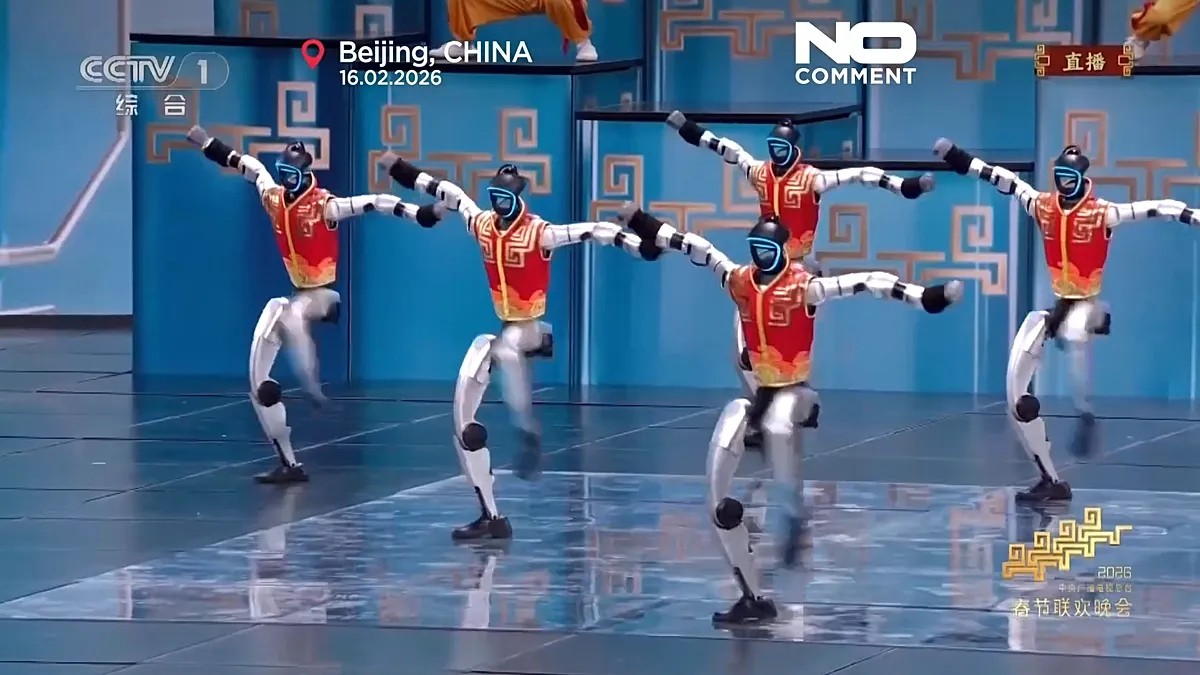
China’s Lunar New Year gala wasn’t just a cultural display this year—it was a technological statement. Humanoid robots performing complex martial arts and parkour routines demonstrated a leap forward in robotics that demands attention, particularly from Europe. These aren’t the wobbly, handkerchief-wielding machines seen in previous displays; the latest generation exhibits significantly improved stability and coordination.
The Breakthroughs on Display
The robots showcased several firsts, including continuous freestyle table-vaulting parkour, aerial flips, single-leg flips, and even a 7.5-rotation Airflare grand spin. This isn’t just about flashy tricks; it signifies rapid progress in AI-powered robotics that requires less human input. The ability to perform complex movements suggests advancements in both hardware—balance, actuators—and software—motion planning, real-time adaptation.
Beyond the Spectacle: Military and Economic Implications
While the gala was a carefully orchestrated performance, the underlying technology has serious implications. Humanoid robots are being tested in factories and warehouses globally, and the potential for home use is growing. More concerning, defense experts point to clear military applications.
“There is likely room for robots in the shape of humans and animals in military and security organisations,” says Hans Liwång, a professor at the Swedish Defence University. “Especially if they are to interact with structures built for humans.”
However, Liwång cautions against overstating current capabilities: “Putting on a rehearsed show does not tell us that much about the state of the technology.” The real test is whether these robots can operate effectively in unpredictable environments, which requires far more than just impressive physical skills.
Europe’s Position in the Robotics Race
Europe doesn’t necessarily need to panic, but it does need to pay attention. China and the United States are currently leading the humanoid robotics race, and Europe risks falling behind if it doesn’t learn from others’ progress.
Liwång stresses the need for Europe to learn from existing efforts rather than starting from scratch. China’s advantage lies in its vertically integrated robotics value chain and strong government backing, allowing for rapid scaling and lower production costs. Unitree Robotics, whose machines were featured in the gala, advertises its G1 humanoid robot for around $13,500, while Tesla aims to produce Optimus at under $20,000 with high-volume manufacturing.
The key takeaway is that technological advancements in robotics are moving quickly. While staged demonstrations can be misleading, the underlying progress is real. Europe must strategically adapt to remain competitive in this rapidly evolving field.