
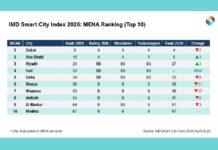



Dubai and Abu Dhabi have emerged as the leading smart cities in the Arab world, securing sixth and tenth place respectively in the IMD Smart City Index 2026. The Swiss business school’s annual ranking, which assesses 148 global cities, reveals that the United Arab Emirates is setting the pace for urban technology, infrastructure, and governance in the Middle East and North Africa (MENA) region.
Saudi Arabia’s Rapid Rise
While the UAE dominates the top tier, Saudi Arabia is making significant strides, with six cities appearing in the MENA top ten, including first-time entries from Hail and Hafar Al Batin. Riyadh has climbed to 24th globally, and AlUla has seen a dramatic rise of 27 places, fueled by rapid tourism and infrastructure investments under the Saudi Vision 2030 plan. This reflects the Kingdom’s aggressive push into AI-driven development, declared its official “Year of Artificial Intelligence” in 2026.
Beyond Technology: The Role of Public Trust
The IMD Index reveals a critical insight: strong institutions and public trust are more reliable predictors of smart city success than technological investment alone. The Gulf region’s high scores in both technology and citizen confidence demonstrate that state-directed digital spending, combined with high-quality service delivery, can translate into genuine public support.
This success is largely due to the Gulf’s focus on improving AI-powered public digital services. The UAE’s UAE PASS digital identity platform and Abu Dhabi’s TAMM superapp (serving 3.6 million users) are prime examples. Similarly, Saudi Arabia’s Tawakkalna app, used by 34 million citizens, is now opening up to private sector integration.
A Growing Divide
The study also highlights a widening gap between Gulf and non-Gulf Arab cities. Cities like Rabat, Cairo, Algiers, and Beirut consistently lag behind, receiving lower ratings (C or D) and experiencing declines in their rankings. The disparity underscores the importance of sustained investment in smart infrastructure and digital governance.
Regional Influence
The Gulf model of smart city development is gaining traction beyond the region. Morocco recently launched its Idarati X.0 superapp project, based on similar design principles as the UAE and Saudi Arabian platforms. This suggests that the region’s success is influencing urban innovation elsewhere in the Arab world.
The key takeaway is that building a truly smart city requires more than just technology; it demands strong governance, public trust, and consistent investment in citizen-focused digital services.