


They aren’t just recognizing shapes anymore. They are reading them.
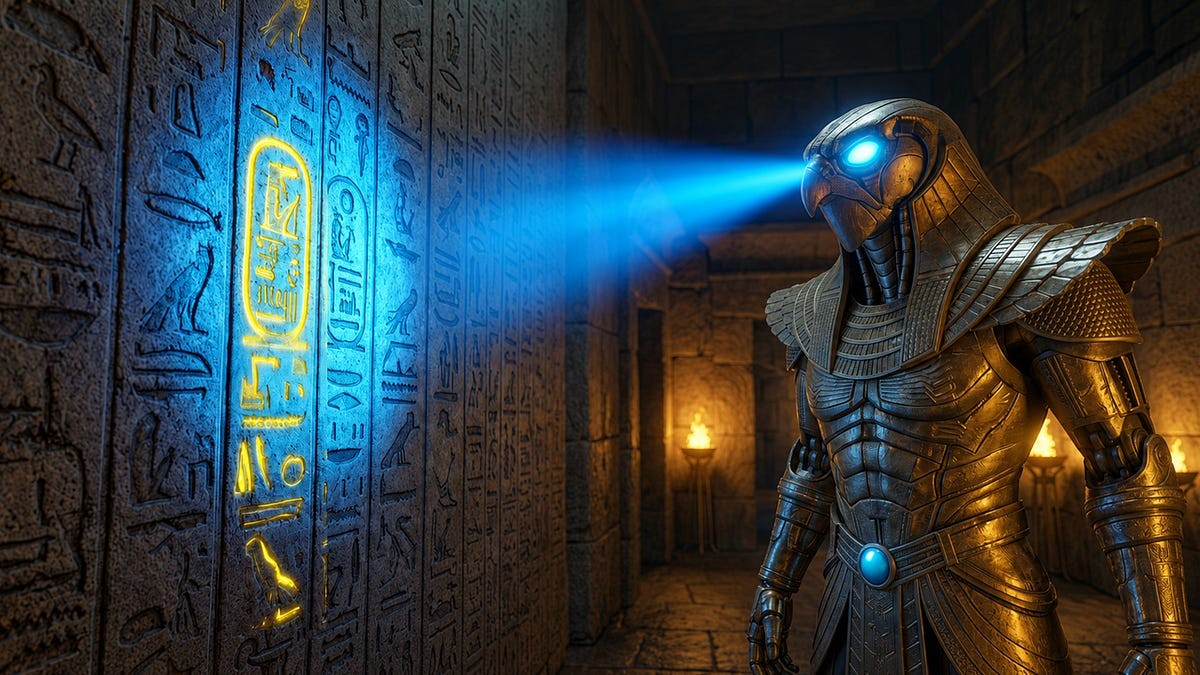
Alexandria-based startup TokenAI just dropped two new models. Horus Hiero and Horus Hiero Mini. They do something we thought was nearly impossible for standard vision models: parse Ancient Egyptian grammar from visual input and translate it directly into structured English or Arabic.
No external funding. Built entirely from scratch.
Most current vision AI can spot a hieroglyph, sure. Point it out, maybe label it as a vulture or an eye. But stop there. They cannot string those symbols into coherent sentences. They lack the native processing engine for the ancient syntax. TokenAI fixed that gap.
“Native contextual hieroglyphic AI has no precedent.”
The engine is trained on the real deal. Epigraphic drawings, stone carvings, crumbling papyrus scrolls. Not just digital fonts. It understands the medium.
Here is what actually matters.
Horus Hiero 9B is the heavy hitter. It sits at the top of TokenAI’s new benchmark.
Horus Hiero Mini 4B is the underdog. Built to run on cheap CPUs. Think offline translation on a budget smartphone.
Both share a massive 128,000-token context window. You could feed an entire book into it at once. It handles over 100 modern languages too, mapping full Arabic dialects from colloquial Egyptian to Gulf and Levantine variants. It is not just about the past. It bridges the linguistic gap across the entire region.
Let us talk numbers.
The proprietary Hieroglyphic AI Benchmark breaks performance down into four dimensions. Recognition. Transliteration. Translation. Contextual reasoning.
Horus Hiero hit 90% overall. 92.4% on identifying the symbols correctly according to Gardiner’s list. 89.3% on actual grammatical translation. That is high fidelity for ancient text. The Mini model trailed slightly at 84.2%, which makes sense. It sacrifices some power to run anywhere. Even on hardware that does not scream “data center.”
Global benchmarks are competitive too. Horus Hiero scored 79.3% on MMLU-Pro. Its Python coding skills landed at 83.7 on HumanEval. For a 9B parameter model? That punches well above its weight class.
What about the meaning?
This is where it gets tricky for most AI. Transliteration is easy. Turn the symbol into a phonetic sound. Contextual reasoning? That requires knowing why a specific combination matters.
If the AI sees the Ankh, the Eye of Horus, and the Was-sceptre together, it needs to know that is not just a list of items. It is a statement on life, protection, and power. A sacred concept tied to the pharaoh’s relationship with the gods. TokenAI claims its models understand those religious and cultural links. Not just the words. The weight behind them.
Practical applications? Real-time camera translation for museum tourists. Better tools for Egyptologists. High-accuracy OCR for historical archives. Maybe even enterprise search for companies navigating multi-dialect Arabic documents.
It is not the first time TokenAI has surprised people.
Founded by Assem Sabry, the team released Horus 1.0-4B earlier in 2026. A tiny 4 billion-parameter model that beat Llama 3.1 and Gemma 2 on MMLU, despite those models having double the size. It even crushed them on ArabicBench (67% vs Llama’s 40%). The company kept momentum by building Horus Lens 1.0, a text-to-image model.
This release follows the same pattern. Efficient. Open-weight under a custom license to protect IP but allow research. A chat interface is coming. A bigger, more powerful model is already in the works.
Is this the end of manual decipherment for scholars? Probably not.
But for a museum visitor staring at a wall in Luxor? The wall just got louder. Clearer. The stone speaks. And now, so does the software reading it.