


Most people know OLED from deep blacks and bright colors in smartphAs. But this technology doesn’t just provide excellent screens in pocket devices. Manufacturers are pushing the boundaries of OLED, creating panels that break conventional design rules. We’re looking at transparent displays that disappear when turned off, as well as top-emitting models that completely transform light control. These aren’t just incremental updates. These are structural shifts in the way we interact with digital information.
Transparent technology and heads-up displays
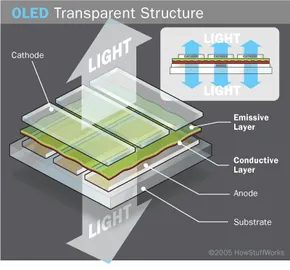
Transparent OLEDs eliminate the traditional opaque layer. The substrate, cathode and anode are all made of transparent materials. When the screen is off, up to 85% of light passes through it. It looks like glass. When the organic compounds is switched on, it emits light in two directions. You can see the content from the front and the back.
This duality enables certain use cases where visibility is important. It doesn’t interfere with the real world. Digital information is layered. This makes the technology an excellent candidate for heads-up displayss and augmented reality windows in vehicles. Active or passive matrix models allow for precise control, but the real selling point is transparency. Retailers can set digital prices on glass doors. Offices can be equipped with information boards that do not block the view between rooms.
“Transparent OLED screens can be active matrix or passive matrix.”
The efficiency of these panels varies depending on the type of matrix, but the visual effect is the same. When the pixel is off, light passes through; when the pixel is on, light is emitted. It creates an eerie, layered aesthetic that even standard LCDs and standard OLEDs can’t match.
Top-emitting OLEDs for smart cards and reflective surfaces
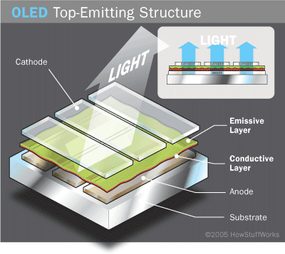
Not all OLEDs can display light from the front. The most emissive OLEDs change the game. The substrate here can be opaque or reflective. This means the light travels up and out of the device instead of through the back. This design is ideal for active matrix designs where each pixel is driven by a thin film transistor backplane.
Why is this important? This enables thinner, more flexible and even foldable structures, so the back layer does not need to be transparent. It can also be creatively combined with other materials. Manufacturers are already considering using smart cards with this technology. Credit cards and access control cards with top-emitting OLEDs can display dynamic information on their surface without the need for battery-draining backlights or complex wiring to front displays.
Reflective substrates can also be used in environments where the ambient light needs to be controlled in a different way. Instead of preventing the glare of the backlit panel, the light is directed outwards. This is a subtle but important engineering choice. This changes the way devices are located and interact with their environment.
Why do these changes exist?
You may be wondering why not all screens are transparent or top-emitting. The answer lies in compromises. Transparent OLEDs usually sacrifice some brightness and color saturation because the light has to pass through several layers. Top-emitting OLEDs can be more complicated to manufacture because they require precise vertical stacking.
But for certain applications, it’s worth the trade-off. A

The hardware behind the flexible screen
Standard OLED panels are rigid. Since it uses a glass substrate, it may break if dropped. Foldable OLED changes physics. Instead of glass, we use a very thin metal film or special plastic. This makes the display layer light and very durable. The advantage for smartphone manufacturers is simple. Reduces missing points due to accidental drops. Return rates are lower. The number of repair shops is also decreasing.
But this app is more than just a gadget. Thanks to the flexibility of the platform, the screen can be woven into textiles. Imagine outdoor survival gear with a computer chip, a GPS receiver and a small OLED screen sewn right into the fabric. The device becomes part of your clothes. It just doesn’t stick together. Integrated.
White OLED as ambient light source
Most people think of OLED as a display. White OLED is different. They do not form images, but emit white light. The output is brighter and smoother than traditional fluorescent tubes. It also has an effect that rivals the true color quality of incandescent bulbs. This is important in commercial spaces, offices and homes, where color accuracy cannot be compromised.
This manufacturing process allows white OLEDs to be made in large continuous sheets. This scalability means that bulky fluorescent bulbs can be replaced. This change has the potential to significantly reduce the energy costs of lighting large buildings. It turns the light source itself into a thin and efficient panel.
Compromises and competition
Before you start replacing all your light bulbs or buying all your flip phones, you need to know how OLED compares to existing technologies. The efficiency benefits are real. Flexible circuit boards can be expected to be durable. However, production costs are still an obstacle to mass use. How does it compare to standard LEDs? What happens when the plastic substrate degrades over time? The answer will determine whether this is just a niche upgrade or the next standard.


